Succession, Organisms, Chemistry¶
Version 1 · Disclaimer
Literature synthesis (lambic.info, Milk The Funk, Mad Fermentationist, Sour Beer Blog, MDPI Beverages 3(4):51, PMC 6252343, PMC 7380088, Lallemand). Condensed from the earlier reference file; homebrew-basics and spontaneous/coolship detail trimmed since this programme uses pitched cultures. Units SI.
1. Microbial succession (the template all protocols manipulate)¶
| Phase | Window | Organisms | Products / role |
|---|---|---|---|
| 1 Enteric | 0–4 weeks | Enterobacter, Klebsiella, Hafnia, Kloeckera | Mixed acids (acetic, lactic, succinic, formic); MCFA precursors (caproic, caprylic, capric) later esterified by Brett. Suppressed by aged hops; largely absent in pitched fermentations |
| 2 Saccharomyces | 1–4 months | S. cerevisiae | Primary attenuation, ethanol, CO₂; POF+ strains generate vinyl phenols. Autolysis later releases B vitamins, amino acids, lipids that feed Brett and Pedio — do not rack off the cake |
| 3 Acidification | 4–8 months | P. damnosus (dominant), Lactobacillus spp. | Bulk lactic acid; pH → 3.2–3.5; possible ropy phase (EPS) — temporary, Brett degrades it |
| 4 Brett maturation | 8 months–3+ years | B. bruxellensis (incl. former lambicus/intermedius), B. anomalus, B. custersianus | Dextrin/oligosaccharide attenuation, ethyl phenols, esters, pellicle, clarification |
Each phase engineers the environment for the next. Pitched-culture programmes compress or delete phases 1 and 3 and must replace their contributions deliberately (MCFA precursors → wort lipids/C8 spikes; lactic backbone → controlled LAB pitch, see 05 §5).
2. Organism notes that matter at this level¶
Brettanomyces - B. bruxellensis: full PAD + VPR; classic 4-EP/4-EG producer. Cantillon-associated strains are metagenomically distinct and 4-EG-skewed. - B. anomalus: ester-forward, tropical; PAD/VPR expressed weakly. - B. custersianus: no PAD gene — zero ethyl phenols regardless of precursor load; esterase still liberates HCAs. Use where fruit/ester character without funk is wanted. - Facultative anaerobe; O₂ → acetic acid and THP. Inhibited by SO₂ (beware sulfited fruit). Ferments cellobiose, dextrins, maltooligosaccharides. - Pellicle = normal; absence ≠ problem.
Pediococcus damnosus — only Pediococcus species found in traditional lambic. Homofermentative, hop-tolerant. Produces diacetyl and EPS (ropiness); both cleaned up by active Brett — Pedio without Brett is a fault machine, with Brett it is the deepest acid engine. Performs malolactic conversion (malic → lactic), relevant to fruit additions (07).
Lactobacillus — early acidifier, superseded by Pedio in tradition. Hop sensitivity is strain-variable; L. acetotolerans recurs in aged sour beers. Controlled single-strain use is covered in 05 §5.
Acetic acid bacteria — aerobic, surface-active, hop-insensitive. Gueuze carries ~0.6–1.2 g/L acetic acid as a flavour-critical minority; control is via oxygen, not sanitation.
3. Acid and flavour matrix¶
| Acid | Character | Source | Note |
|---|---|---|---|
| Lactic | Smooth, clean | Pedio, Lacto | Backbone; lactic:acetic 5:1–10:1 target |
| Acetic | Sharp, vinegary | AAB, Brett+O₂ | Small amounts add lift; blending dilutes linearly |
| Succinic | Vegetal, bitter | Stressed yeast | Minor; unavoidable |
| Malic | Green apple | Malt, fruit | Converted to lactic by Pedio (MLF) |
| Citric | Sharp, green | Fruit | Not converted by MLF; citrus stays sharp |
Gueuze pH 3.2–3.5; TA is a better predictor of perceived sourness than pH — titrate when planning blends (06).
Key esters: ethyl acetate (most abundant; fruity → solvent), ethyl caproate/caprylate/decanoate (tropical, see 03), isoamyl acetate (banana, degraded fastest by Brett esterase). Key phenols: 4-EP (barnyard/leather), 4-EG (clove/smoke), 4-EC (dark medicinal depth) — full pathway treatment in 04.
4. Wort design principles (traditional rationale, adapted)¶
- Grist: 60–70% Pilsner + 30–40% raw wheat (Belgian legal minimum 30%). Raw wheat's arabinoxylan, high-MW protein and hard-to-convert starch are the long-fermentation substrate. Flaked/malted wheat are workable but weaker substitutes.
- Turbid wort logic: unconverted starch + long-chain dextrins (the ≥6-carbon fraction is ~7–9% of carbohydrate in traditional wort) feed Brett for years; enzyme-denatured turbid pulls lock this in. Measured turbid wort: maltose ~60 g/L, maltotriose ~12 g/L, glucose ~8 g/L, higher oligosaccharides <4 g/L, pre-acidified pH ~4.5.
- Practical equivalents ranked: full turbid mash > simplified step mash with turbid pulls (the G30 schedule in 05) > high single infusion (70 °C+) > maltodextrin addition.
- Aged hops: bacteriostatic without bitterness; ~7–8 g/L traditional for spontaneous. For pitched cultures 20–35 g per 25 L suffices; keep <6 IBU wherever LAB activity is wanted. Very old hops add cheesy/herbal notes — moderate rates, isovaleric doesn't blend away.
- Boil: traditional 3–5 h is a volume-reduction artefact. At home scale 60 min preserves the lipid/precursor fraction — longer is counterproductive (see 05 §1).
- OG 1.048–1.055 typical.
5. Vessels, oxygen, storage¶
- Glass carboys sealed with stoppers + airlocks; keep airlocks topped. Loose tops/cotton bungs = surface mould + acetic blowout (empirically confirmed, see 09).
- Oak cubes/spirals (~28 g per 19 L, pre-boiled 30 min) substitute for barrel micro-oxygenation and build reusable house flora; procyanidins from oak act as oxygen sinks, buffering acetic risk.
- Headspace minimal; top up with similar/younger beer; CO₂ flush at sampling.
- Traditional cellars swing seasonally (~8–10 °C amplitude); steady 22 °C removes this driver — temperature strategy in 04 §7.
- Never rack until packaging (autolysis nutrient depot); one racking acceptable if needed.
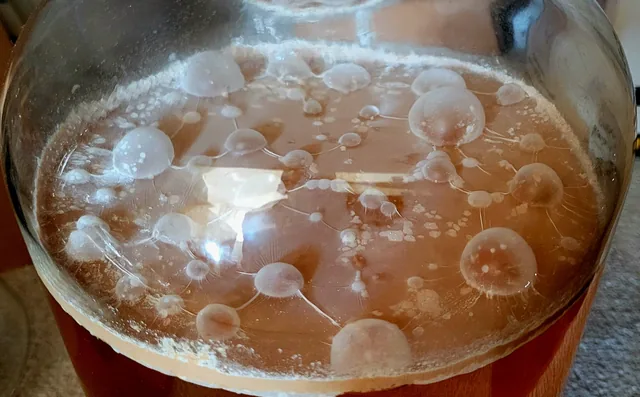 What a lovely pellicle · 2023-05-28
6. Traditional timeline (calibration baseline)¶
1-year lambic = gueuze's young, sugar-bearing component; 2–3-year = character component; classic blend ~60/30/10 young/middle/old; bottle conditioning 1–2 years. Fruit goes onto ≥1-year base for 1–6 months. This programme's compression levers (precursor spiking, temperature staging, controlled LAB, sensory-gated bottling) exist to beat this baseline without losing the profile — see 04 and 05.
7. Troubleshooting quick table¶
| Symptom | Cause | Action |
|---|---|---|
| Ropy/viscous | Pedio EPS | Wait 3–6 months; Brett resolves it; often precedes best depth |
| Butter | Diacetyl, young Pedio | Confirm Brett active; wait |
| Vinegar | O₂/AAB | Fix seals, minimise headspace; blend down |
| White fuzzy surface | Mould from O₂ ingress | Remove, fix seal; distinct from smooth pellicle |
| Vomit/bile | Butyric (Clostridium/enteric) | Dump; does not age out |
| Nail polish | Ethyl acetate excess | Blend down; dump if extreme |
| No carbonation | Yeast dead at pH ≤3.4 | Always bottle with EC-1118; rebottle if caught |
| Band-aid without spikes | Chlorophenols | Campden every brew; check hose/tap water contact |