Fair Isle Tove dregs: isolating the bugs
WB-BUG-2026-022 · colonies · started 2026-09-26
In progress
- Heading for the bank: Brett A, and Brett B in two lines (top layer, stir flask); each in a tube of clear wort at ~30 °C since 2026-11-07.
- Next: around 2026-11-14, a wet mount of each tube, slants under oil, and the rest into a 200 mL mini-beer.
- Closed: the Saccharomyces (2026-10-17, none seen) and the Lactobacillus (2026-10-25, no growth).
Current state
Two Brett, three lines, all on their way to the bank. Brett A, the stir-flask Brett B and the top-layer Brett B were each picked from their last plate into saline and then into a tube of clear wort on 2026-11-07, at ~30 °C. Next weekend each tube is checked under the microscope, slanted under oil, and the rest steps up into a 200 mL mini-beer, all three side by side.
Sample tree
Every tube, plate and saline so far and where it came from, abandoned branches included. Thick outline:
in use; dashed: ended, with the reason; dates are when each was made. IDs read target, form and number:
BRB-PL7 is the seventh Brett B vessel, a plate; LAC-PLS9 a sorbate plate for the Lacto; SA is a
saline, TU a tube, PLL a plate under an agar lid.
%% wb:scroll
%%{init: {"flowchart": {"nodeSpacing": 10, "rankSpacing": 28, "padding": 6, "htmlLabels": false}, "htmlLabels": false, "themeVariables": {"fontSize": "12px", "lineColor": "#8a8a8a"}}}%%
flowchart LR
    n_BOTTLE["`**BOTTLE**
source · 09-26
○ used-up`"]
    n_DREGS["`**DREGS**
source · ?
◇ fridge`"]
    n_SAC_PL1["`**SAC-PL1**
plate · 10-08
✗ nothing at 48 h
10-10`"]
    n_TOP["`**TOP**
source · ?
◇ fridge`"]
    n_WAKE["`**WAKE**
tube · 10-03
◇ fridge`"]
    n_LAC_PLS5["`**LAC-PLS5**
plate, sorbate · 10-10
✗ nothing grew
by 10-17`"]
    n_LAC_PLS6["`**LAC-PLS6**
plate, sorbate · 10-10
✗ nothing grew
by 10-17`"]
    n_SAC_PL2["`**SAC-PL2**
plate · 10-10
✗ Brett only, gate
failed
10-15`"]
    n_SAC_PL3["`**SAC-PL3**
plate · 10-10
✗ Brett only, gate
failed
10-15`"]
    n_LAC_TU_D["`**LAC-TU-D**
tube · 10-11
✗ no Lacto growth
LAC closed 10-25`"]
    n_LAC_PLL1["`**LAC-PLL1**
plate, agar lid · 10-03
✗ no Lacto colony by D7
10-10`"]
    n_LAC_PLL2["`**LAC-PLL2**
plate, agar lid · 10-03
✗ no Lacto colony by D7
10-10`"]
    n_LAC_PLL3["`**LAC-PLL3**
plate, agar lid · 10-03
✗ no Lacto colony by D7
10-10`"]
    n_LAC_PLL4["`**LAC-PLL4**
plate, agar lid · 10-03
✗ no Lacto colony by D7
10-10`"]
    n_BRB_SA13["`**BRB-SA13**
saline · 10-10
◇ fridge`"]
    n_LAC_PLS7["`**LAC-PLS7**
plate, sorbate · 10-10
✗ Brett only
SAC closed 10-17`"]
    n_LAC_PLS8["`**LAC-PLS8**
plate, sorbate · 10-10
○ colony to LAC-PLS9/10,
10-17`"]
    n_LAC_PLS9["`**LAC-PLS9**
plate, sorbate · 10-17
✗ Brett B only
line in BRB-TU12
10-30`"]
    n_BRB_TU12["`**BRB-TU12**
tube · 10-23
● active`"]
    n_BRB_PL14["`**BRB-PL14**
plate · 11-01
● active`"]
    n_BRB_SA15["`**BRB-SA15**
saline · 11-07
○ all into BRB-TU16
11-07`"]
    n_BRB_TU16["`**BRB-TU16**
tube · 11-07
● active`"]
    n_LAC_PLS10["`**LAC-PLS10**
plate, sorbate · 10-17
✗ Brett B only
line in BRB-TU12
10-30`"]
    n_LAC_TU_A16["`**LAC-TU-A16**
tube · 10-11
✗ no Lacto growth
LAC closed 10-25`"]
    n_LAC_TU_A33["`**LAC-TU-A33**
tube · 10-11
✗ no Lacto growth
LAC closed 10-25`"]
    n_LAC_TU_B8["`**LAC-TU-B8**
tube · 10-11
✗ no Lacto growth
LAC closed 10-25`"]
    n_LAC_TU_E["`**LAC-TU-E**
tube · 10-11
✗ no Lacto growth
LAC closed 10-25`"]
    n_LAC_TU_M["`**LAC-TU-M**
tube · 10-11
✗ no Lacto growth
LAC closed 10-25`"]
    n_MOTHER["`**MOTHER**
flask · 09-26
● active`"]
    n_STIR["`**STIR**
flask · 09-26
◇ fridge`"]
    n_MIX_PL1["`**MIX-PL1**
plate · 10-03
✗ mould by 10-07, no
colonies`"]
    n_MIX_PL2["`**MIX-PL2**
plate · 10-03
◇ fridge`"]
    n_BRA_SA1["`**BRA-SA1**
saline · 10-10
◇ fridge`"]
    n_BRA_PL2["`**BRA-PL2**
plate · 10-10
✗ edge contamination
10-12`"]
    n_BRA_PL5["`**BRA-PL5**
plate · 10-17
✗ contaminant patch
superseded
10-30`"]
    n_BRA_SA7["`**BRA-SA7**
saline · 10-23
● active`"]
    n_BRA_PL8["`**BRA-PL8**
plate · 10-23
◇ reserve`"]
    n_BRA_SA9["`**BRA-SA9**
saline · 11-07
○ all into BRA-TU10
11-07`"]
    n_BRA_TU10["`**BRA-TU10**
tube · 11-07
● active`"]
    n_BRB_SA1["`**BRB-SA1**
saline · 10-10
◇ fridge`"]
    n_BRB_PL2["`**BRB-PL2**
plate · 10-10
✗ mould after 15 picks
10-17`"]
    n_BRB_SA5["`**BRB-SA5**
saline · 10-17
✗ superseded by BRB-SA9
10-30`"]
    n_BRB_SA6["`**BRB-SA6**
saline · 10-17
✗ dilution, duplicate of
SA5
10-25`"]
    n_BRB_PL7["`**BRB-PL7**
plate · 10-17
✗ mould
superseded by round 3
10-30`"]
    n_BRB_SA8["`**BRB-SA8**
saline · 10-23
✗ parent of contaminated
PL10
10-30`"]
    n_BRB_PL10["`**BRB-PL10**
plate · 10-23
✗ bacteria and mould
(lid off)
10-30`"]
    n_BRB_SA9["`**BRB-SA9**
saline · 10-23
● active`"]
    n_BRB_PL11["`**BRB-PL11**
plate · 10-23
◇ reserve`"]
    n_BRB_SA17["`**BRB-SA17**
saline · 11-07
○ all into BRB-TU18
11-07`"]
    n_BRB_TU18["`**BRB-TU18**
tube · 11-07
● active`"]
    n_MIX_PL3["`**MIX-PL3**
plate · 10-03
◇ fridge`"]
    n_BRA_SA3["`**BRA-SA3**
saline · 10-10
✗ weak (one colony on
replate)
10-25`"]
    n_BRA_PL4["`**BRA-PL4**
plate · 10-10
✗ edge contamination
10-12`"]
    n_BRA_PL6["`**BRA-PL6**
plate · 10-17
✗ single Brett colony
only
10-23`"]
    n_BRB_SA3["`**BRB-SA3**
saline · 10-10
✗ never plated
MIX-PL3 covers
10-25`"]
    n_BRB_PL4["`**BRB-PL4**
plate · 10-10
✗ edge contamination
10-12`"]
    n_MIX_PL4["`**MIX-PL4**
plate · 10-03
✗ mould after the 10-07
picks`"]
    n_BOTTLE --> n_DREGS
    n_DREGS --> n_SAC_PL1
    n_BOTTLE --> n_TOP
    n_TOP --> n_WAKE
    n_WAKE --> n_LAC_PLS5
    n_WAKE --> n_LAC_PLS6
    n_WAKE --> n_SAC_PL2
    n_WAKE --> n_SAC_PL3
    n_WAKE --> n_LAC_TU_D
    n_TOP --> n_LAC_PLL1
    n_TOP --> n_LAC_PLL2
    n_TOP --> n_LAC_PLL3
    n_TOP --> n_LAC_PLL4
    n_LAC_PLL1 -.-> n_BRB_SA13
    n_LAC_PLL2 -.-> n_BRB_SA13
    n_LAC_PLL3 -.-> n_BRB_SA13
    n_LAC_PLL4 -.-> n_BRB_SA13
    n_TOP --> n_LAC_PLS7
    n_TOP --> n_LAC_PLS8
    n_LAC_PLS8 --> n_LAC_PLS9
    n_LAC_PLS9 --> n_BRB_TU12
    n_BRB_TU12 --> n_BRB_PL14
    n_BRB_PL14 --> n_BRB_SA15
    n_BRB_SA15 --> n_BRB_TU16
    n_LAC_PLS8 --> n_LAC_PLS10
    n_TOP --> n_LAC_TU_A16
    n_TOP --> n_LAC_TU_A33
    n_TOP --> n_LAC_TU_B8
    n_TOP --> n_LAC_TU_E
    n_TOP --> n_LAC_TU_M
    n_BOTTLE --> n_MOTHER
    n_BOTTLE --> n_STIR
    n_STIR --> n_MIX_PL1
    n_STIR --> n_MIX_PL2
    n_MIX_PL2 --> n_BRA_SA1
    n_BRA_SA1 --> n_BRA_PL2
    n_BRA_SA1 --> n_BRA_PL5
    n_BRA_PL5 --> n_BRA_SA7
    n_BRA_SA7 --> n_BRA_PL8
    n_BRA_PL8 --> n_BRA_SA9
    n_BRA_SA9 --> n_BRA_TU10
    n_MIX_PL2 --> n_BRB_SA1
    n_BRB_SA1 --> n_BRB_PL2
    n_BRB_PL2 --> n_BRB_SA5
    n_BRB_SA5 --> n_BRB_SA6
    n_BRB_SA6 --> n_BRB_PL7
    n_BRB_PL7 --> n_BRB_SA8
    n_BRB_SA8 --> n_BRB_PL10
    n_BRB_PL7 --> n_BRB_SA9
    n_BRB_SA9 --> n_BRB_PL11
    n_BRB_PL11 --> n_BRB_SA17
    n_BRB_SA17 --> n_BRB_TU18
    n_STIR --> n_MIX_PL3
    n_MIX_PL3 --> n_BRA_SA3
    n_BRA_SA3 --> n_BRA_PL4
    n_BRA_SA3 --> n_BRA_PL6
    n_MIX_PL3 --> n_BRB_SA3
    n_BRB_SA3 --> n_BRB_PL4
    n_STIR --> n_MIX_PL4
    classDef default fill:transparent
    classDef live stroke-width:3px
    classDef banked stroke-width:3px,stroke-dasharray:1 2
    classDef gone stroke-dasharray:4 3,opacity:0.55
    class n_MOTHER,n_BRA_SA7,n_BRB_SA9,n_BRB_TU12,n_BRB_PL14,n_BRB_TU16,n_BRB_TU18,n_BRA_TU10 live
class n_MIX_PL1,n_MIX_PL4,n_SAC_PL1,n_SAC_PL2,n_SAC_PL3,n_BRA_PL2,n_BRA_SA3,n_BRA_PL4,n_BRB_SA3,n_BRB_PL4,n_LAC_PLS5,n_LAC_PLS6,n_LAC_PLS7,n_LAC_TU_A33,n_LAC_TU_A16,n_LAC_TU_B8,n_LAC_TU_E,n_LAC_TU_D,n_LAC_TU_M,n_LAC_PLS10,n_BRA_PL6,n_BRB_SA8,n_BRB_PL10 goneSource
A bottle of Tove, Fair Isle: an oak-aged ale refermented with blackberries. Batch not recorded. Opened and tasted on 2026-09-26; the tasting notes are on the Fair Isle Tove tasting note.
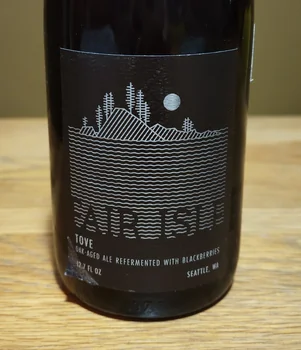 Tove, Fair Isle: oak-aged ale refermented with blackberries
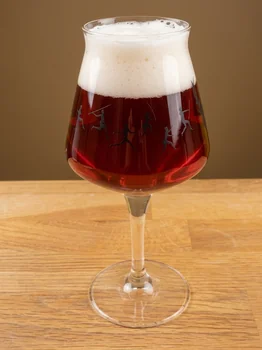 In the glass, 2026-09-26
I am after the Saccharomyces strain(s) and the Lactobacillus, especially as I do not currently have a Lactobacillus in the bank I am satisfied with. Brett is optional.
The isolation follows a written plan (fair-isle-tove, v5), made with the bottle dregs analysis skill. Log headings cite its steps (P01, P02 ...). Tubes, plates and salines are named by their sample IDs;
the sample tree shows where each came from.
What else was in the bottle
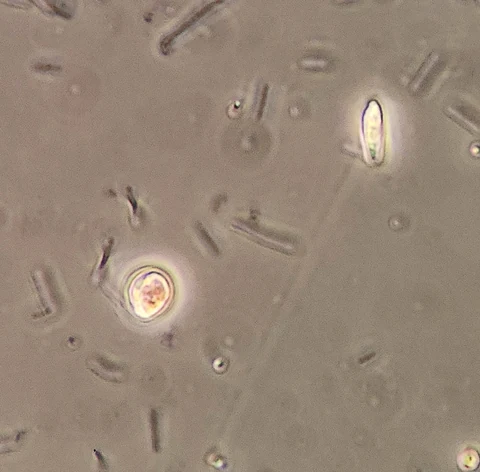
The dregs on opening were dominated by thin rods, singles to short chains. Among them were a few round cells with thick walls and grainy contents, and some elongated cells. My reading at the time: old Saccharomyces-like cells, Brett, and one rod population (presumptive). No Pediococcus seen.
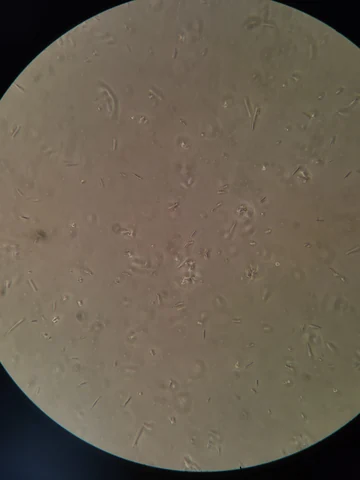 Dregs on opening, full eyepiece field · 1000x, phase contrast, unstained, not to scale
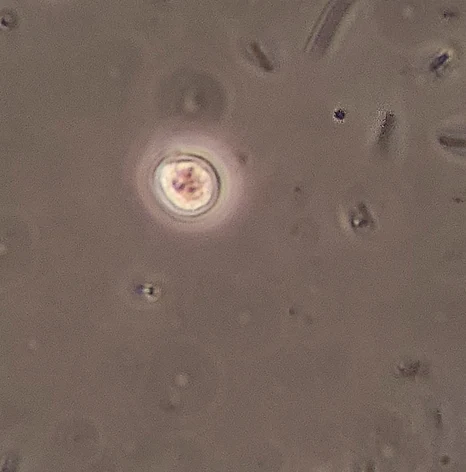 Round cell, grainy contents · 1000x, phase contrast, unstained, not to scale
 Round and elongated cells · 1000x, phase contrast, unstained, not to scale
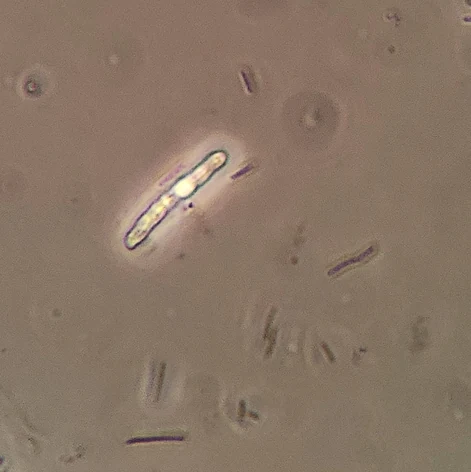 Elongated cell · 1000x, phase contrast, unstained, not to scale
Plating and colonies
| Colony | Round | Medium | Days | Temp (°C) | Morphology | Notes |
|---|---|---|---|---|---|---|
| Stir flask, 3 streak plates, MIX-PL1 to MIX-PL3 (P02) | 1 | Wort agar | 4 | ~21 | Tiny, fairly uniform colonies, probably 50+ per plate | Least diluted plate (MIX-PL1) lost to mould, no visible colonies. Not picked yet |
| Stir flask, 1 busy plate, MIX-PL4 (P02c) | 1 | Wort agar | 4 | ~21 | Tiny colonies, barely visible, about the same size | Three colonies picked for the microscope: presumptive Brett, two morphologies. Plate then lost to mould |
| Top-layer tube, 4 plates with an agar lid, LAC-PLL1 to LAC-PLL4 (P03) | 1 | Wort agar, agar lid | 4 | ~31 | Nothing visible |
Microscopy
Stir flask and top-layer tube, 2026-10-01
From the stir flask: ovoid cells in short chains, about 6.1 x 3.5 µm, some with one pointed end, and narrow elongated cells about 6.2 x 1.9 µm. From the top-layer tube: thin rods, about 0.5 to 0.6 µm wide. Sizes measured on the calibrated camera (20 px/µm).
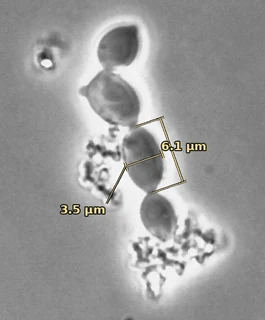 Stir flask, ovoid cells · 1000x, phase contrast, unstained
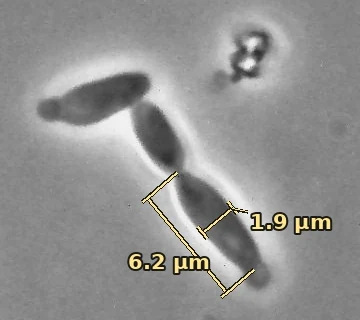 Stir flask, narrow cells · 1000x, phase contrast, unstained
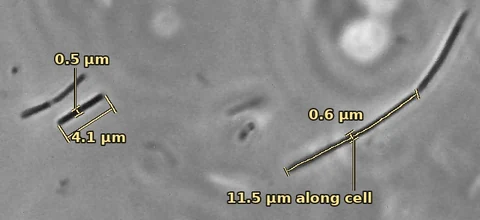 Top-layer tube, rods · 1000x, phase contrast, unstained
Colonies from plate MIX-PL4 (P02c), 2026-10-07
Three colonies on one slide. Round, pointy cells and narrow ones: both probably Brett, but two distinct morphologies. My reading of the frames (observation): oval budding cells about 3.5 to 5 x 4 to 6 µm, some with one pointed end; long cells joined end to end with a pinched joint and buds clustered at the joint; and narrow dark cells about 1.5 to 1.8 µm wide in pairs and short chains. No rods like those in the top-layer tube.
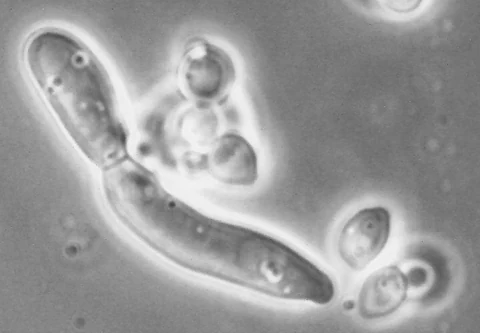 MIX-PL4 colonies, elongated cells · wort agar, 4 days, ~21 °C · 1000x, phase contrast, unstained, not to scale
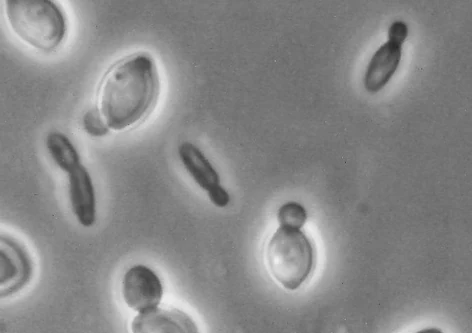 MIX-PL4 colonies, both morphologies · wort agar, 4 days, ~21 °C · 1000x, phase contrast, unstained, not to scale
Outcome
To follow.
Log
2026-09-26 · Source
Bottle opened and tasted. Dregs kept in two fridge tubes: one with the full dregs (DREGS), one with the top portion of the rested dregs (TOP). A mother culture (MOTHER; 1 mL dregs in 200 mL hopped wort, 25 to 30 IBU, static, airlock) and a stir flask (STIR; 1 mL dregs in 150 mL wort, stir plate) were also started the same day. The stir flask was my head start: aeration to give the fast-growing bugs a lead.
2026-09-27 · Observed
Dregs under the microscope: rods dominant, a few round, grainy, thick-walled cells and some elongated cells.
2026-10-01 · Plan adopted (v5)
Targets: the Saccharomyces and the Lactobacillus; Brett optional. Mother culture silent at day 6 (clear wort, few cells), stir flask active with many budding cells.
Key decisions: plate the stir flask for the yeasts; plate the top-layer tube under a thin agar lid for the Lacto; a head-start tube from the stir flask, plated busy and read at day 2, to give the Saccharomyces its best chance; a Lacto wake-up tube in hopped wort. No controls, counts or viability tests; dilutions by loop steps, judged by eye. Lacto to be banked in chalk stabs with a beer backup. No purchases.
2026-10-03 · Plating round 1 (P02a, P02b, P02, P02c, P03)
- P02a/P02c: the stir flask is the head start (P02a); P02c is one busy plate from it (MIX-PL4), wort agar, ~21 °C.
- P02: stir flask, 3 streak plates at different dilution levels (MIX-PL1 to MIX-PL3), wort agar, ~21 °C.
- P03: top-layer tube, 4 plates with an agar lid (LAC-PLL1 to LAC-PLL4), ~31 °C.
- P02b: about 0.5 mL of the top-layer tube into a hopped-wort tube (the wake-up tube, WAKE), filled to the brim, ~31 °C.
2026-10-07 · Day 4 (P02, P02c, P03, P02b)
- P02: least diluted plate (MIX-PL1) lost to mould, no visible colonies. Tiny, fairly uniform colonies on the other two (MIX-PL2, MIX-PL3), probably 50+ each.
- P02c (MIX-PL4): tiny colonies, barely visible to the naked eye, about the same size. Three picked for the microscope: round, pointy cells and narrow ones, both probably Brett but two distinct morphologies. Plate then lost to mould.
- P03 (LAC-PLL1 to LAC-PLL4): nothing visible.
- P02b (WAKE): sediment against the tube wall; cloudy when swirled. Not yet under the microscope.
No Saccharomyces-type colony (large, creamy, early) on any plate. Next: one last Saccharomyces plate on 2026-10-08, and WAKE under the microscope.
2026-10-08 · Last Saccharomyces attempt (P09)
A few drops of the full dregs on a spare wort plate (SAC-PL1) at ~30 °C, read at 48 h: nothing. Under the microscope the Lacto wake-up tube (WAKE, day 5) was mostly Brett, with sparse thin rods and one clump of round cells of 4 to 6 µm, which I took as a possible Saccharomyces.
2026-10-10 · Day 7, and the plan changes course (P02, P03, P10 to P14)
The agar-lid plates for the Lacto never grew a bacterial colony and went in the bin. The stir-flask plates, on the other hand, now show two kinds of colony: larger, solid cream ones and many tiny ones. Under the microscope these are two Brett types. Brett A has small roundish to ovoid cells, grows more slowly and makes the bigger, more solid colonies. Brett B has long cylindrical cells and small translucent colonies that look transparent under side light and turn solid as they age or when the light is turned.
The mother culture, silent at day 6, now has a white pellicle and is fermenting with no acetic smell. It is Brett. My guess is that Brett B makes the pellicle. I am keeping it airlocked as the reference blend.
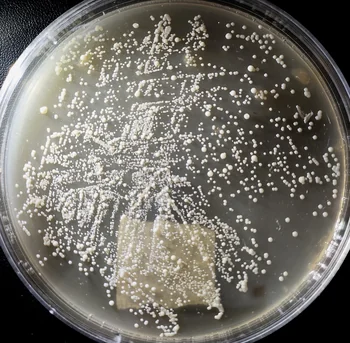 Stir-flask plate MIX-PL2 with both Brett types: larger solid colonies (A) and tiny ones (B) · wort agar, 14 days
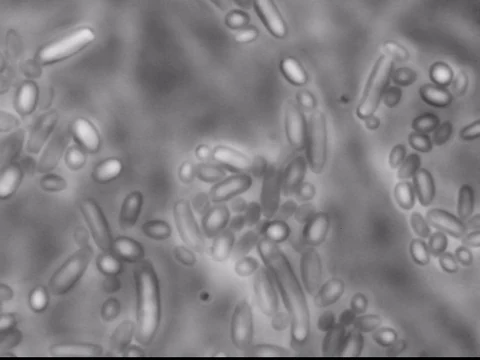 Mother culture pellicle · hopped wort, 14 days · 1000x, phase contrast, unstained
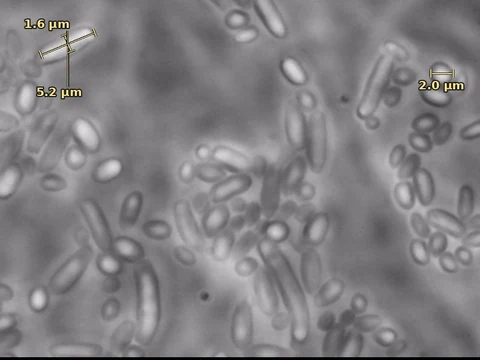 Same field, measured · 1000x, phase contrast · cylindrical cell 5.2 x 1.6 µm, round cell 2.0 µm across (n = 1 each, hand-placed, ±0.3 µm)
Round 2 set up the same evening:
- Brett A and Brett B, first purity round: colonies of each kind picked into saline, one saline per kind from each of the two stir-flask plates (BRA-SA1 and BRB-SA1 from MIX-PL2, BRA-SA3 and BRB-SA3 from MIX-PL3), each plated at ~30 °C (BRA-PL2, BRA-PL4, BRB-PL2, BRB-PL4). The saline tubes stay at 4 °C as backups.
- Saccharomyces: the wake-up tube on two wort plates (SAC-PL2, SAC-PL3), read at day 2 and 3.
- Lacto: four wort plates with potassium sorbate (1.9 g/L) to hold the yeast back, from the wake-up tube (LAC-PLS5, LAC-PLS6) and from the top-layer tube (LAC-PLS7, LAC-PLS8), in a sealed box at ~30 °C.
2026-10-11 · A liquid test for the Lacto (P15)
Nothing has grown the rods on wort so far, so I am asking a different question: does it want beer and hops? Six full 15 mL tubes, each with 0.3 mL of the top-layer tube (the wort-with-sorbate tube took the wake-up tube instead): Budvar at about 33, 16 and 8 IBU (cut with water and wort; LAC-TU-A33, LAC-TU-A16, LAC-TU-B8), plain wort (LAC-TU-E), wort with sorbate (LAC-TU-D), and a hop-free mock beer (LAC-TU-M). Kept at 24 to 25 °C in an airtight box. Plan updated to v6.
2026-10-12 · Lost plates
Three of the four Brett purity plates (BRA-PL2, BRA-PL4, BRB-PL4) were lost to growth creeping in from the edge of the plate, I think bacterial. The dishes were reused after an alcohol soak, which does not kill spores. New dishes ordered; the saline backups mean nothing is lost but time.
2026-10-15 · The first Lacto colony (P10, P13)
The Saccharomyces plates from the wake-up tube grew Brett of both kinds and nothing else: that route has failed. The sorbate plates from the wake-up tube stayed blank. The ones from the top-layer tube were covered in Brett, which grew straight through the sorbate. But one plate (LAC-PLS8) carried a single larger, flat, white colony with a fuzzy edge. Under the microscope: the same thin rods I saw in the dregs on day one. After almost three weeks of trying since the bottle was opened, the first Lacto colony.
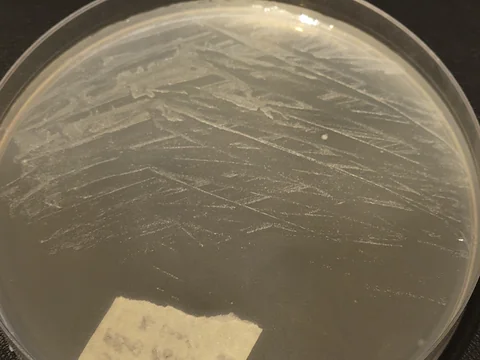 Sorbate plate LAC-PLS8, from the top-layer tube: Brett along every streak · wort agar + 1.9 g/L sorbate, 5 days, ~30 °C
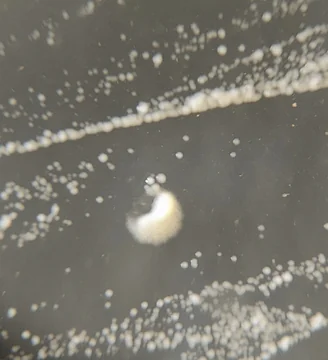 The Lacto colony among the Brett, under a magnifier · same plate, 7 days
2026-10-17 · Purity round 2 (P16)
- Lacto: the colony restreaked onto two sorbate plates (LAC-PLS9, LAC-PLS10), one spread with a few loops of saline on the plate and one from a saline suspension. Brett colonies touched it, so I expect some Brett to come along.
- Brett B: the first-round plate (BRB-PL2) shows only one kind of colony. I picked 15 of them into saline (BRB-SA5), diluted it (BRB-SA6), and plated again (BRB-PL7), keeping both salines as backups. I purify by colony type rather than from a single colony, so the strain keeps its diversity.
- Brett A: replated from its saline backups on new dishes (BRA-PL5, BRA-PL6).
- The tubes for the liquid test are still clear at day 6, with some sediment; first look under the microscope tomorrow.
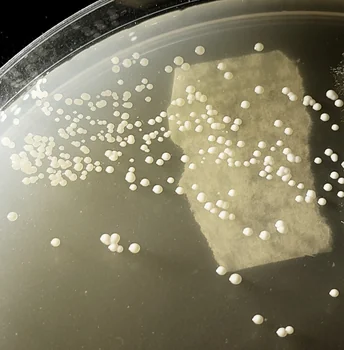 Brett B after its first purity round (BRB-PL2): one kind of colony · wort agar, 7 days, ~30 °C
2026-10-17 · The Saccharomyces closed; the Lacto tubes parked (P10, P13, P15)
The last Saccharomyces lead, a few solid white round colonies on the sorbate plate LAC-PLS7, was Brett under the microscope. No round Saccharomyces cells anywhere, so that target is closed. The liquid-test tubes for the Lacto were still clear at day 6; the rod counts were too low to mean anything, so from now on I only check them by eye.
2026-10-23 · Day 6: Brett A, Brett B and the Lacto restreak (P11, P13, P16)
- Brett A: one replate (BRA-PL5) grew plenty of the big white colonies, with one flat, wrinkled patch of something else spreading near the top; the other (BRA-PL6) grew a single colony and went in the bin. Under the microscope, oval cells with buds at one end, as before. I picked colonies well away from the patch into saline (BRA-SA7) and plated again (BRA-PL8).
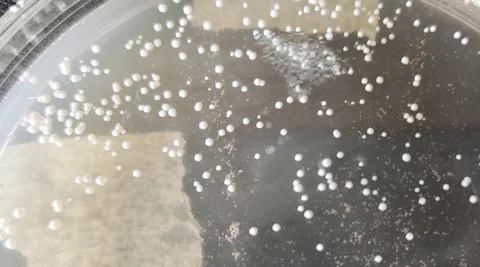 Brett A replate (BRA-PL5) with one contaminant patch · wort agar, 6 days, ~30 °C
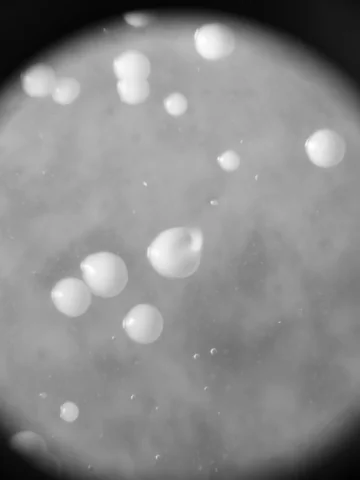 Brett A colonies under a magnifier · same plate
- Brett B: round 2 (BRB-PL7) had mould starting at the edge, and two sizes of colony: tiny ones on their own and bigger ones along the streak. So not one kind yet. I picked each kind separately into saline and onto a plate (tiny: BRB-SA8, BRB-PL10; bigger: BRB-SA9, BRB-PL11).
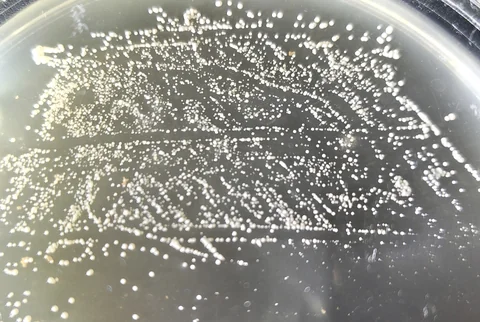 Brett B purity round 2 (BRB-PL7) · wort agar, 6 days, ~30 °C
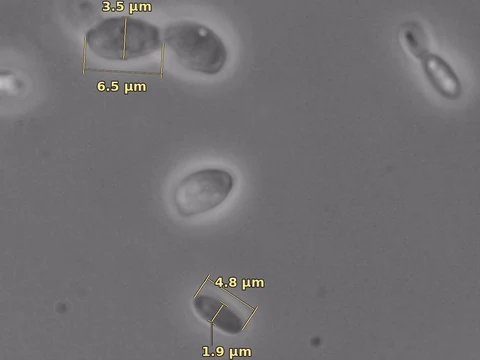 Brett A cells from the replate · wort agar, 6 days, ~30 °C · 1000x, phase contrast, unstained · oval cells 5.7 to 6.5 x 3.5 µm (n = 2), elongated cell 4.8 x 1.9 µm (n = 1)
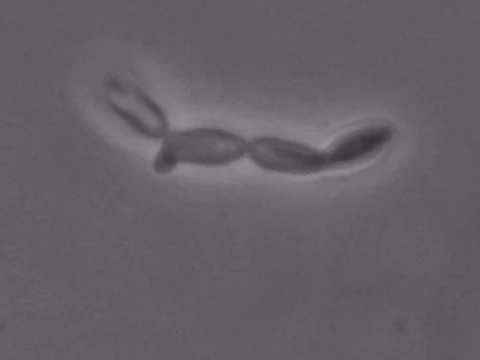 Brett B cells from round 2 · wort agar, 6 days, ~30 °C · 1000x, phase contrast, unstained
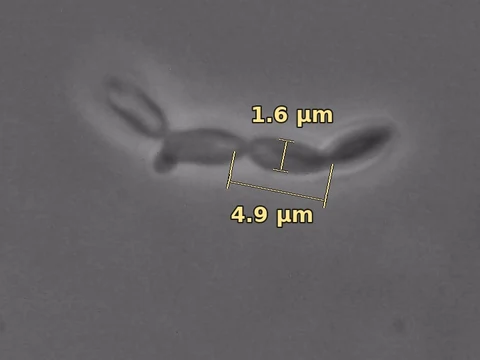 Same field, measured · 1000x, phase contrast · long cells 3.5 to 4.9 x 1.3 to 1.6 µm (n = 3)
- Lacto: both restreaks of the Lacto colony (LAC-PLS9, LAC-PLS10) came up with a few hundred identical colonies, and no flat, fuzzy one like the Lacto. Under the microscope they are Brett B: the Brett that touched the Lacto colony came along, and the Lacto did not. With no plates left, I put a few of these colonies into 5 mL of wort (BRB-TU12) as a second Brett B line, this one from the top-layer tube.
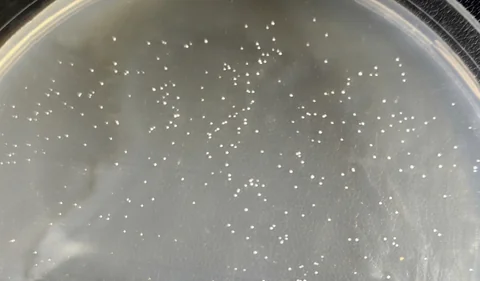 The Lacto restreak (LAC-PLS9): only Brett came up · wort agar + 1.9 g/L sorbate, 6 days, ~30 °C
2026-10-24 · Plan v7
The plan is rewritten around the Brett: purity rounds by colony kind until each plate shows one kind under the lens and the microscope, then slants under mineral oil, a chalk plate, a phenol test and a mini-beer for each. The Lacto had one last check left in its tubes.
2026-10-25 · The Lacto closed; Brett B under the microscope (P21, P22)
No haze in any of the liquid-test tubes, so I discarded them: the Lacto is closed for good. Its only colony grew once, on a sorbate plate, and never again.
The two Brett B salines from round 2 look the same under the microscope: oval and teardrop cells, long cells budding at both ends and long filaments, often joined in one cluster. So the two colony sizes are probably one Brett growing in several shapes, not two strains. The round-3 plates will tell. The tube from the top layer (BRB-TU12) shows only long cylindrical cells in chains, very even: the cleanest Brett B so far, and the one I will streak first.
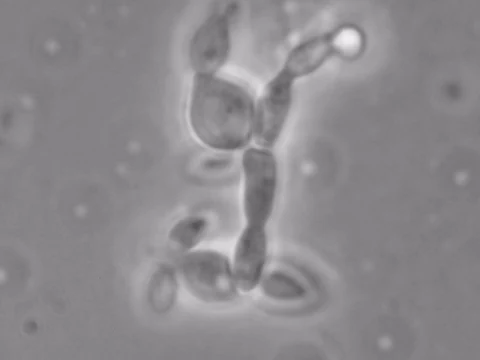 Brett B pick: long and teardrop cells in one cluster · saline from round 2 · 1000x, phase contrast, unstained
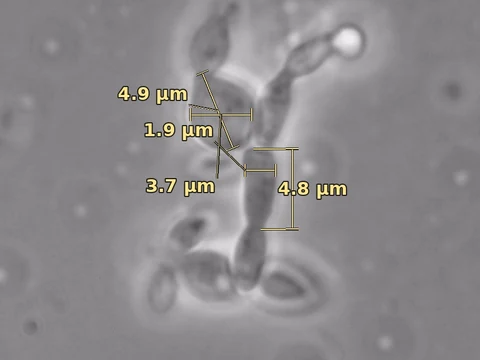 Same field, measured · 1000x, phase contrast · long cell 4.8 x 1.9 µm, teardrop cell 4.9 x 3.7 µm (n = 1 each; teardrop hand-placed, ±0.3 µm)
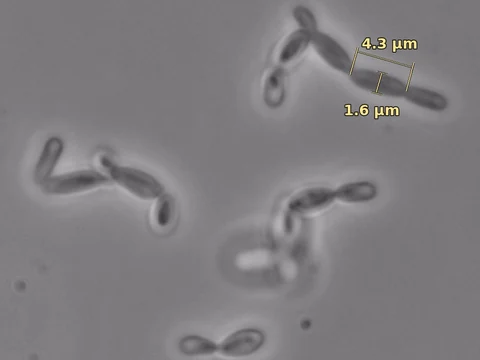 Brett B from the top-layer line (BRB-TU12): long cells only · wort, 2 days, ~30 °C · 1000x, phase contrast, unstained · long cells 3.2 to 4.7 x 1.5 to 2.0 µm (n = 9)
2026-10-30 · Round 3 read (P21, P22, P23)
A week at ~30 °C. One plate had fallen into a backpack and lost its lid for a while after plating; it was almost certainly BRB-PL10, which came up with mould, a flat spreading growth and two big yellow colonies. Under the microscope the yellow colonies are bacterial cocci in pairs and fours, a skin-and-dust type rather than anything from the beer (reading, Med). The Brett on it is still Brett B, but the plate is gone.
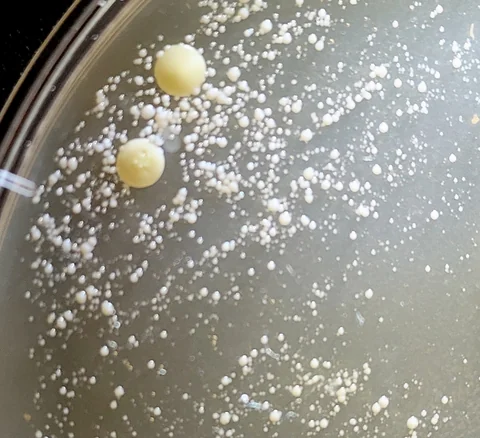 The plate that fell lid-off: two yellow contaminant colonies among Brett B · wort agar, 7 days, 29 to 31 °C
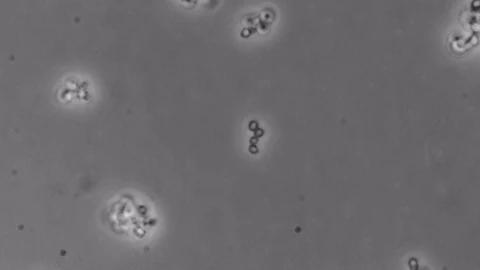 The yellow colony: bacterial cocci in pairs and tetrads · wort agar, 7 days, 29 to 31 °C · 1000x, phase contrast
Its twin, BRB-PL11 (the bigger-colony kind), is clean: small white colonies of one look, and only the pointed and cylindrical Brett B cells under the microscope. Brett A on BRA-PL8 is clean too, but showed some much larger oval cells beside the usual ones, so I held it for a closer look before banking.
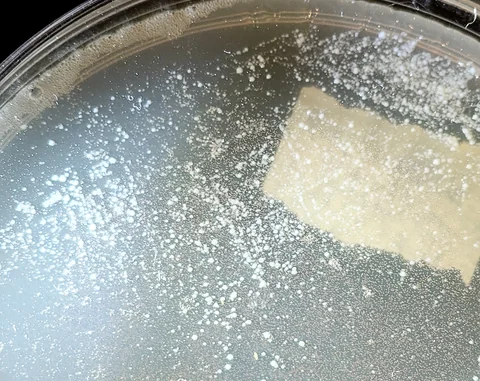 Brett B round 3 (BRB-PL11): one colony kind · wort agar, 7 days, 29 to 31 °C
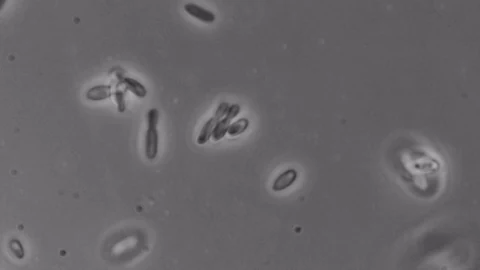 Brett B round 3: ogival and cylindrical cells · wort agar, 7 days, 29 to 31 °C · 1000x, phase contrast
2026-10-31 · Brett A cleared; plan v8 (P23)
I mounted three separate Brett A colonies. All three show the same mix: ovoid cells budding at the ends, some larger cells and a few elongated ones. So it is one Brett that varies in shape, not a second yeast hiding in the colonies (reading, Med). The colonies all look alike under the lens, and the plate smells strongly of Brett: not pungent, but loaded and rich.
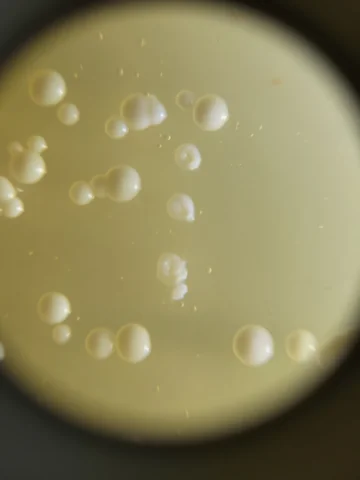 Brett A (BRA-PL8): one colony kind, three sampled · wort agar, 8 days
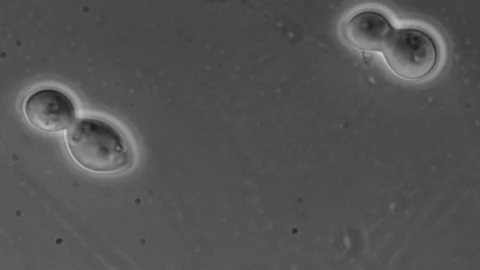 Brett A, third colony: the larger budding cells seen in all three colonies · wort agar, 8 days (7 at 29 to 31 °C, then 4 °C) · 1000x, phase contrast
The plan is rewritten for banking (v8): no more purity plates, except one from the top-layer Brett B tube (BRB-TU12). The two Brett B lines, stir flask and top layer, are kept apart and compared by smell and in mini-beers, since the cells alone cannot say whether they are the same strain.
2026-11-07 · The top-layer Brett B plated and picked (P29, P30)
The top-layer Brett B plate (BRB-PL14) grew the tiny colonies I expected after six days at ~30 °C, but also some flat bacterial colonies like the ones on the lid-off plate. The yeast colonies themselves were intact, so I scooped many of them into saline and scanned the slide thoroughly: no odd-shaped yeast. The photos show narrow cylindrical and pointed cells, budding in pairs and chains, the same form as the tube it came from (reading, Med), and no bacteria in the fields photographed.
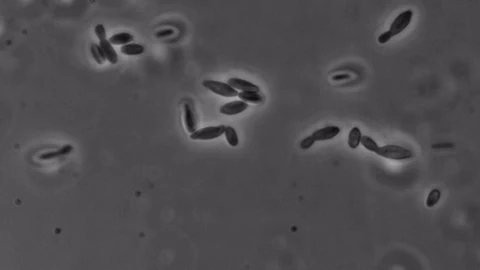 Top-layer Brett B picked for banking: one kind · pooled colonies in saline, from wort agar · 1000x, phase contrast
Banking changes route: rather than slanting straight from the plates, each line goes into a tube of clear wort first. When the tube has grown and looks right under the microscope I slant from it, and the rest of the tube seeds that line's mini-beer. The wort step should also show up any bacteria carried over from the plate before anything is slanted.
The same evening I scraped many colonies from the other two plates into saline: Brett B from the stir-flask line (BRB-PL11) and Brett A (BRA-PL8). Each saline went whole into its own wort tube. The stir-flask Brett B looked to me like it might have some Brett A in it; the cells read as narrow pointed and cylindrical Brett B only, with none of the broad ovals of the Brett A (reading, Med), but the tube will settle it. If it shows Brett A, that tube goes. The Brett A looks clean: broad oval cells of mixed size and the odd long chain, the same as on its plate.
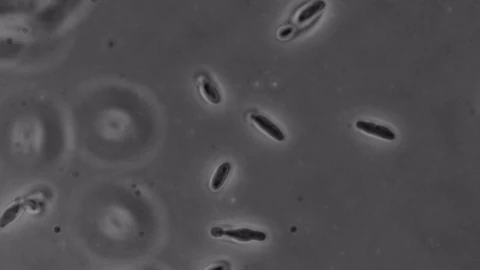 Brett B, stir-flask line, picked for banking: narrow pointed and cylindrical cells · pooled colonies in saline, from wort agar · 1000x, phase contrast
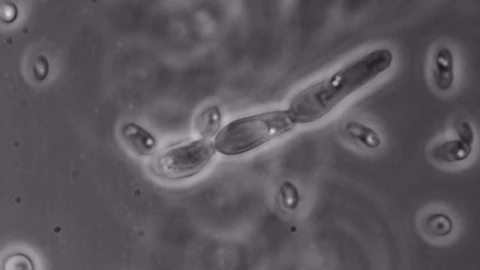 Brett A picked for banking: a pseudohypha among ovoid cells · pooled colonies in saline, from wort agar · 1000x, phase contrast