003 — Aronia¶
WB-ING-2026-003 · status: designed · Disclaimer
Related: Maillard preparations · Skill user guide
Safety
Experimental home procedure. Read the disclaimer first.
Date: 2026-09-17 (rev 2: Direction C selected, 100 g aronia held raw in the freezer) · Skill: fruit-maillard-prep v5 · Calculator: prep_calc.py on design-000.json
1. Request summary¶
400 g crushed aronia pulp, 60 g chopped dates, 60 g cracked dried sloe (whole, stone in) and wheat DME on hand, plus one batch already run: everything combined in a single jar, based with ~6 g KHCO₃, no reduction, 60 min at 121 °C, slow-cooled overnight in the cooker. Result: black-chocolate-dominant, aromatic, complex; most tannin gone, some remaining. The brief is for the properly designed version of that ingredient set, not a repeat of the method — and the stated preference is to preserve aronia character while adding complexity from the process.
Entry mode: 1, ingredients-first. Rev 1 of this document selected the direction that most literally reproduced the original single-pot method (everything cooked, nothing held back) and only patched its execution — which meant carrying over things that were never actually correct, including zero deliberate nitrogen. That was a mistake: a jar that's actually functioning as a Stage B pyrazine jar needs a real nitrogen dose regardless of what the original batch happened to use. This revision selects Direction C instead, because 100 g of the aronia is already held raw in the freezer — the raw Stage D reserve the "preserve character" goal needs is not hypothetical, it's already in hand. Selection and recommendation now coincide; there is no gap to flag.
Scale: one 4.5 L carboy, the skill's default. Total fruit across all stages is 520 g (400 g aronia + 60 g sloe + 60 g date) into 4.5 L = 116 g/L, about 16 % over the accent anchor's 100 g/L ceiling and well under fruit-forward's 200 g/L floor. Carried as accent with the overshoot stated, not relabelled — see §12.
0. Directions (mode 1)¶
| Thesis | Dominant mechanism | Sacrifices | Rough formula | |
|---|---|---|---|---|
| A. Single Stage C jar | Everything combined, unbased, one cook — closest to the original method | Stage C only | No raw fraction at all: none of the fresh aronia colour or aroma survives, and dosing real nitrogen into an all-in-one jar mostly suppresses it (aronia/sloe tannin is a pyrazine suppressor) rather than using it | 400 g aronia + 60 g sloe (A2'd stone) + 60 g date, one unbased jar |
| B. Split pyrazine / phenolic, no raw reserve | Stage B (date, properly nitrogen-dosed, based to 6.15) for cocoa/roast depth, separate unbased Stage C (aronia, sloe) for structure | B + C | Still no raw fraction — same total loss of fresh colour and aroma as A, in exchange for a real cocoa axis this time | B: 60 g date + glycine + Phe, based. C: 400 g aronia + 60 g sloe, unbased |
| C. Split B / C / D, raw reserve (selected) | As B, but the 100 g of aronia already in the freezer goes in raw, post-primary, instead of into the cook | B + C + D | Costs some concentration in the cooked jar (only 300 g of aronia there instead of 400 g) | B: 60 g date + glycine + Phe, based. C: 300 g aronia + 60 g sloe, unbased. D: 100 g aronia, raw (already frozen), post-primary |
| D. Minimal-cook / tincture-forward | Most of the aronia stays raw; a small unbased Stage C jar plus a spirit tincture add complexity without dominating | C (small) + T + D (majority) | Weakest cocoa/caramel and phenolic depth of the four — under-uses the sloe and date already on hand | C: 150 g aronia + 60 g sloe, unbased, short cook. T: aronia pomace in spirit. D: 250 g aronia raw |
Why C: it is the only direction that gets both halves of the stated goal at once. The raw 100 g Stage D fraction is where "preserve aronia character" actually lives — fresh anthocyanin colour and glycoside-bound aroma that a cook destroys regardless of pH or base dose (chemistry.md §8). The 300 g Stage C jar keeps the tannin-forward, phenolic/caramel result the original batch was liked for. The new Stage B jar is where "add complexity" comes from: a genuine, correctly nitrogen-dosed pyrazine axis the original batch never had, because aronia and sloe's tannin actively suppresses pyrazine formation when everything is cooked together (chemistry.md §7) — separating the date out is what lets that chemistry actually happen. Direction A only ever reproduces the original result; Direction B gets the cocoa axis but not the character; Direction D under-uses the sloe and date for no benefit once the freezer fraction makes C available at no extra cost.
2. Formula by stage (accent, one 4.5 L carboy)¶
| Stage | Applies? | Material | g | Purpose, flavours and aromas |
|---|---|---|---|---|
| A1 pectin pre-treatment | n/a | – | – | Nothing here needs a viscosity/juice-yield step |
| A2 kernel hydrolysis | yes | Cracked sloe stone (separated from the dried sloe before jarring) | 14 | Kernel emulsin → benzaldehyde (marzipan) and HCN. The vent removes most of the HCN before it reaches the jar |
| Water | 70–140 mL | Hydrolysis medium, 5–10× stone mass | ||
| B pyrazine jar | yes | Date, Medjool-type, chopped | 60 | Low-asparagine reducing-sugar backbone; already near the Brix target on its own |
| Glycine | 1.2 | Bulk amine: alkylpyrazines (roasted hazelnut, cocoa) — the cocoa axis the original batch didn't have | ||
| L-phenylalanine | 0.5 | Phenylacetaldehyde (honey) in the jar, becoming 2-phenylethanol (rose) in the beer | ||
| KHCO₃ | 0.17 full / 0.14 first pass | Moves the jar to pH 6.15. Date's own TA is tiny (1.8 meq), so this dose is small — dose and measure anyway, the arithmetic is the same discipline regardless of size | ||
| C phenolic jar | yes | Aronia pulp, crushed (cooked fraction) | 300 | Chlorogenic → some caffeic; the tannin that was suppressing pyrazine formation in the original single pot is now doing exactly what it's for — structure and phenolic complexity, no longer fighting the cocoa axis |
| Sloe, dried, whole (stone cracked), flesh + skin | 60 | Very high acid and tannin, native pH 3.3 | ||
| Vented A2 kernel slurry (from above) | (from A2) | Marzipan fraction, route C | ||
| KHCO₃ | 0 | Unbased by default (v4) — proanthocyanidin depolymerisation and tannin softening run better acid than based | ||
| D raw fruit into beer | yes | Aronia pulp, frozen, thawed | 100 | This is where fresh colour and free aroma actually survive. Added post-primary, as for kriek |
| T tincture | n/a | – | – | Not used — the raw D fraction already covers the "fresh character" role a tincture would otherwise be reaching for |
| Beer-side | yes | Lallzyme Beta | 225 mg | 50 mg/L post-primary, once glucose is gone. Releases glycoside-bound aroma from the Stage D fruit and whatever survived Stage C |
| Bottling | yes | EC-1118 | usual | Standing practice; observed here to clean up THP |
Stage B is 14 g/L of concentrate — comfortably inside the accent anchor (10–30 g/L). Total fruit across B+C+D is 116 g/L, ~16 g/L over the 100 g/L accent ceiling; not resized here, see §12 for why that's a minor, explainable overshoot rather than a real sizing error.
3. Nitrogen¶
- Glycine 1.2 g (15.96 mmol) + L-phenylalanine 0.5 g (3.02 mmol) = 18.98 mmol reactive amine. No collagen.
- Against Stage B's 37.8 g RS (from the date alone, ≈209.8 mmol as hexose-equivalent), that's a sugar:amine ratio of 11.1:1 — solidly inside the preferred 10–14:1 band. Glycine-only-plus-Phe carries no Lys or Arg, so the 10:1 collagen rule doesn't apply; the ratio here is chosen for balance between pyrazine yield and FAN load, not because a THP constraint requires it.
- Added FAN: 20 mg N/L — under the 30 mg N/L warn line, with headroom. This is the one place rev 1 of this document got it wrong: it carried the original batch's zero-nitrogen forward into a Stage C jar, which was defensible (Stage C isn't a pyrazine target), then would have needed to carry the same logic into a Stage B jar, where it does not apply — Stage B is specifically the nitrogen-target stage, and skipping the dose there would mean building a "pyrazine jar" with nothing in it to make pyrazines from.
- Added 2-phenylethanol: 21.5–43 mg/L, reaching into the useful 40–100 mg/L band at the top end. Protein carried in: 1.2 g (date), Lys+Arg 22 mg — trivial, no THP argument needed.
4. Base dose per jar¶
Stage B: date's native pH (5.8) sits near malic acid's second pKa, so the anchored solve falls back to the unanchored v3 estimate for it (flagged automatically) — this matters little in practice because the date's TA is tiny. Full dose 0.17 g KHCO₃ (1.7 meq), first pass 0.14 g, target pH 6.15. Add in two or three portions, stir, measure cold, titrate the remainder in, record predicted vs measured even at this small scale — the discipline is the same regardless of dose size.
Stage C — unbased by default (v4): mixture native pH 3.45 (aronia 300 g + sloe 60 g only, no date in this jar this time), TA 90 meq. KHCO₃ = 0 g. This is unchanged from rev 1's reasoning and still holds: proanthocyanidin depolymerisation runs better acid-catalysed, and anthocyanin colour loss doesn't care about pH either way, so basing this jar buys nothing. If your original ~6 g KHCO₃ dose is remembered from the single-pot batch — that arithmetic doesn't transfer here, because this jar no longer carries the date's buffering and is a different mass; don't reuse the number.
5. Ingredients list¶
| Item | Needed | Buy / check |
|---|---|---|
| Aronia, crushed pulp | 400 g total: 300 g into Stage C now, 100 g already frozen for Stage D | Thaw the frozen 100 g just before adding to the beer, post-primary |
| Sloe, dried, whole, stone in | 60 g | Crack stones before jarring; separate ~14 g of stone for A2, return the flesh to Stage C |
| Medjool-type date, chopped | 60 g | No added sugar or oil coating |
| Glycine | 1.2 g | Food/supplement grade |
| L-phenylalanine | 0.5 g | Food/supplement grade |
| Potassium bicarbonate | 0.2 g (small margin over the 0.17 g full dose) | Held |
| A2 water | 70–140 mL | Tap water, boiled and cooled |
| Lallzyme Beta | 225 mg | Held. Weigh dry on the 1 mg scale |
| EC-1118 | bottling dose | Held |
Not needed: wheat DME, phosphoric acid, collagen, papain.
Why DME is dropped: it is a quarter-to-third as Maillard-reactive per gram as invert sugar and contributes almost no nitrogen (~1.6 mg FAN/g). Batch-log 001's own retrospective on this same ratio found it supplied roughly 40 % of a trivial amine pool while adding 11 g (per 100 g aronia) of the least reactive sugar present — "a poor trade" — and the date alone already carries the Stage B backbone this design needs (it's already at Brix target, see §6). Dropping it costs nothing measurable; keep it only if the malt note specifically is wanted.
6. Cook and process¶
A2 (sloe stone):
- Crack and separate ~14 g of stone from the 60 g of dried sloe before it goes into Stage C.
- Crush, cover with 70–140 mL water.
- Hold 40–50 °C, ≤2 h — the kernel slurry sits near pH 5.5, low-acid, capped at 2 h even though it's cooked afterwards.
- Vent 10 min uncovered just below the boil, stirring. Bitter-almond smell check: strong in the water, faint in the drained solids.
- Return the vented slurry to Stage C (route C).
Stage B:
- Crush the 60 g date, stir in 1.2 g glycine and 0.5 g Phe.
- No hob reduction needed. The date alone reads ~68 °Brix on the calculator's lower-bound estimate — already inside the 60–68 target band, because dates arrive near 70 °Brix on their own. Confirm on the jam refractometer before sealing regardless; don't skip the read just because the arithmetic says it should be fine.
- Add the 0.14 g KHCO₃ (first pass) in portions, stir, measure cold, titrate to pH 6.15, record predicted vs measured.
- Fill jar to 85–90 % (10–15 % headspace). Lid finger-tight. Stand in 3–5 cm of water in the pressure cooker, alongside the Stage C jar.
- 121 °C, 90–120 min from full pressure — nitrogen-loaded, at Brix target, this is the pyrazine-branch duration, not Stage C's shorter structural cook.
- Slow-cool, sealed — safe here because water activity (a_w 0.80–0.86 at this Brix) is below every relevant growth minimum.
- Hot-vent 5–10 min before blending.
Stage C:
- Crush the 300 g aronia, add the 60 g sloe flesh and the vented A2 kernel slurry. Measure native pH.
- No hob reduction, no added water — Stage C is protected by acidity, not water activity, and going in wet is fine here.
- Fill jar 85–90 %. Stand in the same cooker, separate jar.
- 121 °C, 20–30 min from full pressure — a structural cook, not a pyrazine cook.
- Hot-vent 5–10 min.
- Cool fast — ice bath or running water to below 5 °C, then refrigerate ≤5 days at ≤3 °C. Do not slow-cool this jar in the sealed cooker: at this water activity (~0.95) and without a verified F₀ at the cold spot, a slow transit through 55→20 °C is the textbook C. perfringens/B. cereus window (§14).
Stage D: thaw the 100 g of frozen aronia. Add to the beer post-primary, alongside the blended B and C pastes and the (previously vented) kernel slurry.
Beer-side sequence: once primary is done, blend Stage B and Stage C into 4.5 L of beer, add the thawed Stage D aronia, and hold at fermentation temperature. Fermentable load is worst-case 19.1 g/L (86 g total) — over the 10 g/L threshold — so add everything early in secondary (the D fraction is small enough on its own to time by flavour, but doing it alongside B/C keeps the accounting simple and lets it ferment out inside the normal gravity check rather than needing separate tracking under the Stage D carve-out). Once gravity is stable, add 225 mg Lallzyme Beta and hold 2–4 weeks. Rack, then bottle only on a stable gravity read twice, 4–6 weeks apart. Store bottles dark (kernel material).
7. Predicted compound inventory¶
| Stage | Axis | Compounds | Sensory |
|---|---|---|---|
| A2 | Marzipan | benzaldehyde | bitter almond, cherry-stone |
| B | Nut / cocoa | 2,5-dimethylpyrazine, trimethylpyrazine and related alkylpyrazines (glycine-led) | roasted hazelnut, cocoa, toast — the axis the original batch was missing |
| B | Honey | phenylacetaldehyde | honey, hyacinth |
| C | Caramel / furanone | furfural, HMF, furaneol, maltol, cyclotene (native-pH-favoured band) | dark caramel, dried-fruit — close to what the original single-pot batch produced |
| C | Polyphenol | chlorogenic → some caffeic; proanthocyanidin monomers/oligomers | dark chocolate, cocoa-nib bitterness, softened astringency |
| C | Funk precursor | ferulic/p-coumaric → 4-vinylguaiacol/4-vinylphenol (native pH, no base needed) | clove edge, feeds Brett VPR later |
| D | Fresh aronia | intact anthocyanin, free and glycoside-bound volatiles, malic/quinic acid | fresh berry, tart, red/purple colour — none of this exists in a fully-cooked jar |
| Beer (later) | Norisoprenoid | β-damascenone from carotenoid/glycoside pool, acid- and time-driven | honey, stewed-apple, rising over 12–18 months |
8. Survives vs destroyed (18 months)¶
Survives: alkylpyrazines (nut/cocoa, from Stage B), furanones (partly reduced over a long secondary), melanoidin body from Stage C, the phenolic/tannin structure from acid-catalysed depolymerisation, 4-vinylguaiacol/4-vinylphenol feeding Brett's VPR route, β-damascenone (rises with age), Stage D's malic tartness.
Transformed: phenylacetaldehyde → 2-phenylethanol (honey → rose), Stage D's free and glycoside-bound aroma partly rearranged by Brett (linalool-type compounds if present; aronia's own volatile pool is more phenolic than terpene, so this is a smaller effect here than in a floral-forward design), benzaldehyde → benzyl alcohol if it meets active fermentation (mitigated by adding post-primary).
Destroyed regardless of any of the above: Stage B and C's anthocyanin — gone at the cook, permanently, no matter the pH or base dose. This is exactly what Stage D's raw 100 g is there to compensate for, and it's the one thing no amount of process correction to the cooked stages can recover.
9. Fusel, methionol, 2-PE, FAN and THP budget¶
| Value | Threshold | Warn? | |
|---|---|---|---|
| Added isoamyl-type fusels | 0.3–0.5 mg/L | 25 mg/L | No |
| Added methionol | 0.03–0.06 mg/L | 0.5 mg/L midpoint | No |
| Added 2-phenylethanol | 21.5–43 mg/L | 40–100 useful band | Reaches the band at the top end |
| Added FAN | 20 mg N/L | warn >30 | No — comfortable margin |
| Lys+Arg carried | 22 mg | – | Trivial, from date protein only |
All clear, with real headroom on the FAN axis if more pyrazine push is wanted later (see tweak points).
10. Kernel calculation¶
- A2 run: yes, assumed 70 % hydrolysis completeness (Med-low, unverified — check by smell).
- Effective HCN retention: 0.58.
- Benzaldehyde: 5.91 mg/L potential → 1.66–2.07 mg/L in the beer, "in range" against the 0.5–2 mg/L threshold.
- HCN: 0.338 mg per 375 mL bottle → 24.2 % ARfD for one bottle, 48.3 % for two — no formal warning (the line is 50 %) but close enough to be worth minding on two-bottle sittings. 50 % ARfD on this jar's chemistry would be reached at ~29 g of stone; this design uses ~14 g.
- Unchanged from rev 1, and still the correction that matters most if the original batch put the cracked stones straight into the cook with no A2 step: unhydrolysed amygdalin most likely arrived in that beer largely intact, for Brett to release as HCN in bottle over the coming months, unvented. If that batch's destination beer volume is ever recorded (it's still the open item on batch-log 001), the same maths above can be rerun against it.
11. Colour and body impact¶
Stage B and C both destroy their anthocyanin at the cook, regardless of pH — expect that fraction of the beer to move several SRM darker, brown-leaning. The Stage D fraction is where colour actually survives: 100 g of raw aronia carries its anthocyanin and free/glycoside-bound aroma straight into the beer untouched by heat. Expect a beer that reads mostly dark/melanoidin from the cooked stages with a genuine fresh red-purple and tart edge from the raw fraction — the closest this ingredient set gets to "preserve character and add complexity" at the same time.
12. Fermentable load¶
- Planned (25 % Stage B / 10 % Stage C reacted, Med confidence; Stage D never "reacts" in the jar): 73 g / 16.1 g/L, ΔABV +1.04 %.
- Worst case: 86 g / 19.1 g/L, ΔABV +1.24 %. Plan on this figure.
- Over the 10 g/L "add early in secondary" line — see §6. Stage D's own sugar (8 g, 1.8 g/L) sits under the Stage-D carve-out in principle, but is folded into the same early-secondary addition here rather than tracked separately, which is simpler and safer.
- Sizing: total fruit 116 g/L is ~16 % over the accent anchor's 100 g/L ceiling while Stage B concentrate (14 g/L) sits comfortably inside 10–30 g/L. The overshoot is entirely in the unbased C+D fruit mass, not the Maillard-active Stage B jar — if it needs to be brought fully inside the anchor, trim Stage C's aronia from 300 g to ~250 g (proportionally, sloe to ~50 g); not done here since it would eat into the raw-reserve ratio's intended 3:1 C:D split for no chemical reason.
13. Beer-side acid, potassium and FAN¶
- Free fruit acid carried in: 24.0 meq/L, from the unbased Stage C (20 meq/L) and Stage D (4 meq/L). Expect this to lower beer pH, the wanted direction for a sour.
- Potassium added: 15 mg/L — trivial, from the tiny Stage B base dose. Nowhere near the 500 mg/L warn line.
- Added FAN: 20 mg N/L, under the 30 mg/L warn line.
- Malate is MLF substrate; aronia/sloe's acid load reads that way if LAB is present in the base beer.
14. Safety, warm hold¶
- A2 kernel hold: 40–50 °C, capped at ≤2 h (low-acid slurry). Compliant.
- Nothing is held warm and then used uncooked: the A2 slurry is hydrolysed, vented (a sub-boil pasteurisation), then cooked again in Stage C. Stage D is never held warm — straight from freezer to thaw to beer.
- Stage B: slow cool is safe (water-activity protected).
- Stage C: fast cool, ≤5 days at ≤3 °C, as specified in §6. If the original single-pot batch was slow-cooled overnight sealed in the cooker, that combination (high moisture, no verified F₀ at the cold spot, slow transit through 55→20 °C) is the specific pattern this skill's Stage C default was rewritten to avoid — worth not repeating, independent of whether anything went wrong in that particular batch.
15. Safety, compounds¶
- Acrylamide: Stage B carries glycine (competes for the dicarbonyl pool, a recognised acrylamide-reducing measure) and uses date as a low-asparagine backbone — both of the two most useful levers are already in this design. Stage C runs at native pH (~3.45), well below the pH that most favours formation.
- Furan: hot-vent done on both B and C.
- HMF: no inversion step run in either cooked jar, so no over-acidification risk from that route.
Confidence tags on load-bearing claims¶
- Native pH figures (Stage B unanchored fallback; Stage C 3.45) and the base-dose arithmetic: Med (arithmetic High; underlying ingredient pH/TA are literature typicals — measure before trusting).
- A2 kernel completeness 0.70 and HCN retention 0.58: Med-low, unverified — do the smell check.
- Stone-fraction estimate (14 g from 60 g of whole dried sloe): Med-low, scaled from batch-log 001's own estimate for the same recipe ratio.
- 2-PE and pyrazine yield from the Stage B dose: Med-low on the Strecker yield (per
chemistry.md§10), High on the arithmetic. - Warm-hold and Stage C cooling hazard framework (§14): High, standard low-acid food-safety reasoning.
Tweak points¶
- Push pyrazines harder: there's FAN headroom (20 of 30 mg N/L used). Raising glycine toward ~1.6 g would tighten the ratio toward 10:1 and push more amine into the reaction without tripping the warn line — a reasonable next-batch experiment, not required here.
- Protect more aronia colour and freshness: increase the Stage D fraction (e.g. hold back more than 100 g next time) at the cost of Stage C's concentration — a direct dial, not a structural change.
- Trim the kernel margin: if two-bottle sittings are a real scenario, cut the sloe-stone kernel dose, or extend the A2 hold and re-check the smell test before assuming 70 % completeness.
- Mind the fermentable-load timing: 19.1 g/L worst case is real — add everything early in secondary and don't skip the second stable-gravity read.
What was actually done¶
Aronia pulp 400 g, chopped dates 60 g, cracked dried sloe (whole, stone in) 60 g, wheat DME 60 g, potassium bicarbonate ~6 g, water 120 mL. Aronia squashed by hand, everything mixed together — thick but wet consistency, no reduction. Pressure-cooked 60 min from pressure, then left to cool overnight inside the sealed cooker. Result: smell and taste black-chocolate dominant, very aromatic and complex; most tannins gone, some remaining (possibly aronia's own character rather than residual astringency). Since then, 100 g of aronia has been held back raw in the freezer.
Analysis: what was got, and why¶
The flavour. On the same jar composition, ~6 g of KHCO₃ (undosed to any measured target) lands at roughly pH 4.5, inside the 3.0–4.5 furanone/caramel band rather than the 6.0–6.3 pyrazine band an earlier, pre-v4 reading of this style of batch assumed. With effectively no deliberate nitrogen in the mix (DME's contribution is trivial), there was never enough free amine for genuine alkylpyrazine/Strecker chemistry to dominate. "Black chocolate, aromatic, complex" reads much better as furanone and caramelisation chemistry plus aronia and sloe's own polyphenol conversion — the same reading chemistry.md §1 now gives the closely comparable batch already in the log (downgraded from High to Med confidence for exactly this reason). That's a genuinely good outcome for an unbased, low-nitrogen, high-tannin cook — it isn't a defect to fix, which is why Stage C in the design above keeps that same character rather than departing from it.
The tannin. "Most gone, some remaining" tracks proanthocyanidin depolymerisation: heat plus acid converts the harshest astringent tannin polymers into smaller flavour-active phenolics, and this runs better the more acidic the jar is — better at ~pH 4.5 than a fully based 6.15 would have been, better still fully unbased. What's left is either slower-reacting oligomers or aronia's own native flavour compounds; that instinct about "actual aronia flavour" is plausible and consistent with the chemistry.
Why the design changed shape. Rev 1 of this document tried to stay as close as possible to the single-pot method and only patch its safety and execution details — which meant it also inherited the zero nitrogen dose, on the reasoning that Stage C isn't a pyrazine-target stage. That reasoning is correct for Stage C but doesn't generalise: it isn't a reason to build a whole design with no nitrogen anywhere. Once the 100 g of frozen raw aronia is factored in, the right move is a real Stage B jar — properly dosed with glycine and Phe, based to 6.15 — run alongside an unbased Stage C jar that keeps the character of the original batch, with the frozen fraction going in raw as Stage D. That's Direction C, and it's the one built out above: it gets a genuine cocoa/roast axis the original batch never had, keeps the phenolic/caramel result that batch was liked for, and recovers fresh colour and aroma through the raw fraction — all three at once, which a single combined jar structurally cannot do.
The kernels and the cool-down. Both corrections from the first draft still apply and are unchanged here: the cracked sloe stones need A2 hydrolysis and a vent before they go anywhere near the cook (skipping it, as in the original batch, likely sent most of the amygdalin into the beer intact for slow release in bottle), and Stage C needs a fast cool and short, cold fridge hold rather than a slow overnight cool sealed in the cooker — the latter is the specific high-moisture, unverified-F₀ pattern this skill's current Stage C process was rewritten to avoid.
Log¶
2026-09-17 · Designed¶
Design intaken from design-000-aronia-ingredients-first.md (rev 2: Direction C selected). The single-pot batch described in "What was actually done" above was cooked 2026-09-10 to 2026-09-11, before this design; 100 g of aronia was held back raw and frozen at that time, feeding this design's Stage D reserve. Stages B, C and D as designed here have not yet been prepared.
Photos¶
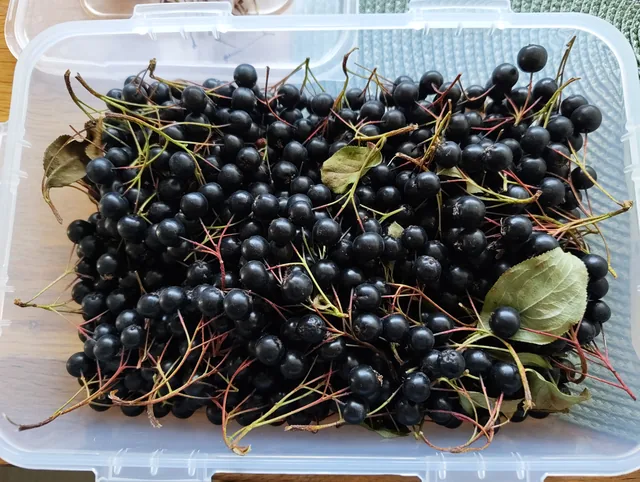 Fresh aronia, hand-picked at the allotment · 2026-09-06
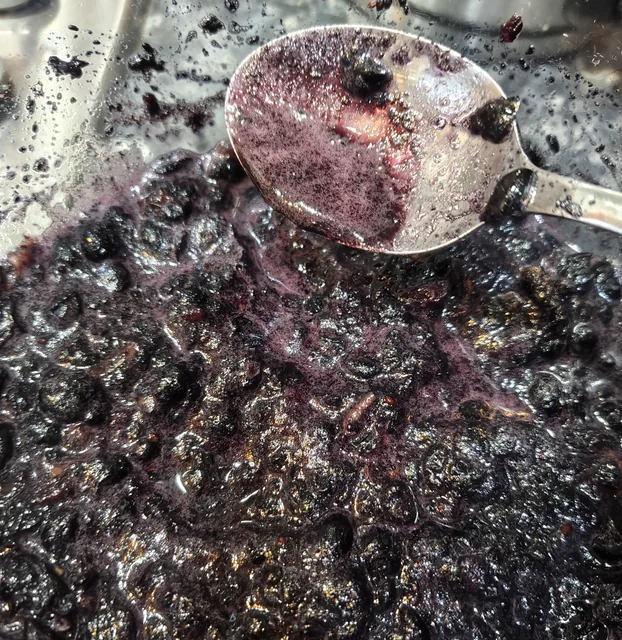 Aronia pulped by hand with a spoon, to see how much water it released · 2026-09-10
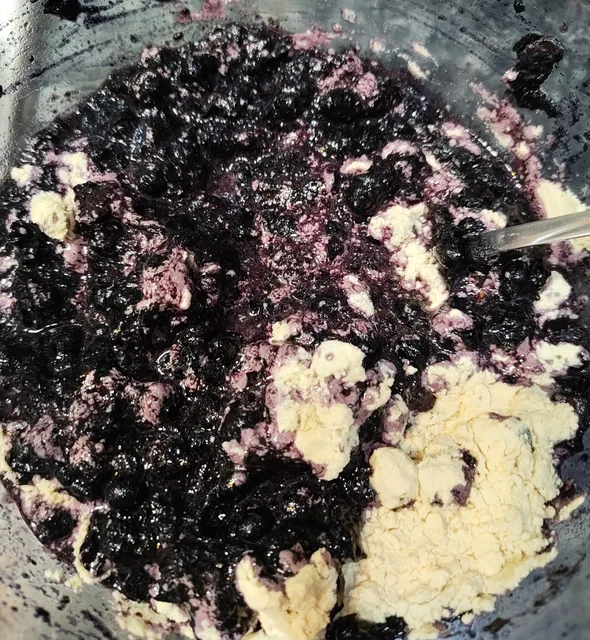 Mixing the aronia pulp with the rest of the ingredients · 2026-09-10
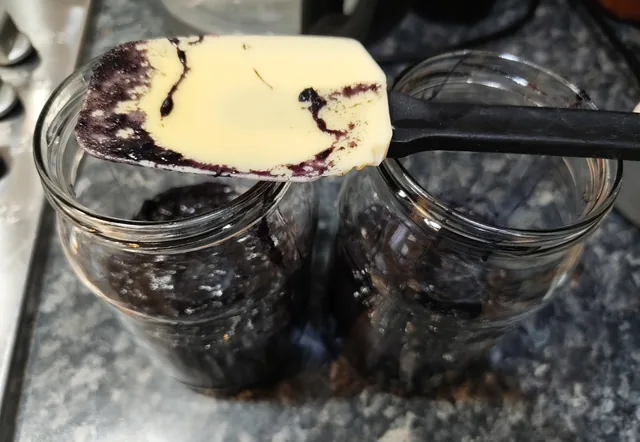 The finished mix packed into jars, ready for the pressure cook · 2026-09-10
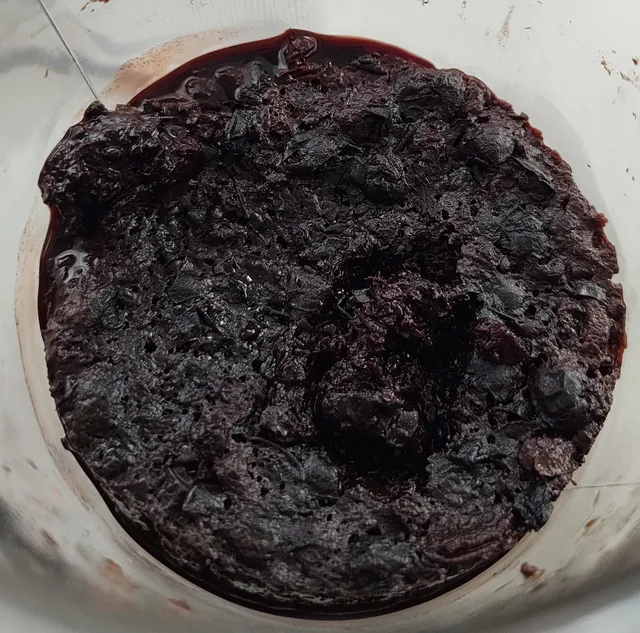 After the pressure cook and overnight cool: the finished colour and texture · 2026-09-11
2026-09-22 · Renumbered¶
Design number changed from 000 to 003 so that it matches the page ID, WB-ING-2026-003. The source file names (design-000-…, design-000.json) are unchanged.