Cantillon Rosé de Gambrinus: tasting note
Tasted 2025-08 (month from the earliest slant) · done
Isolated
- Isolate: Cantillon Rosé de Gambrinus - Brett, banked; the lacto not kept; Cantillon Rosé de Gambrinus journey.
- Why: how could I pass on a Cantillon isolate; probably good for fruit beers.
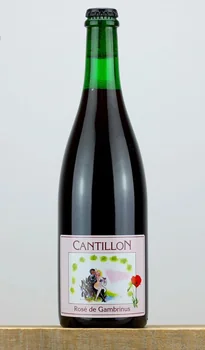 Bottle.
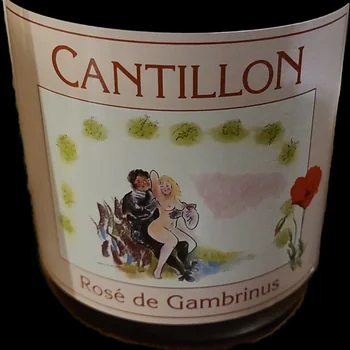 Label.
Impression
A lovely raspberry lambic with an unassuming character. Many flavoured and fruited lambics I come across (many in the homebrew world) tend to go over the top with flavours. I prefer subtle beers, and this one ticked all the boxes for me. The raspberry flavour and colour are present, but do not dominate the beer or cast shadows over its many other interesting flavours and aromas. A very easy beer to drink; I loved it, and would not mind coming across another bottle.
The beer
Researched 2026-10-18 from published sources (numbered below), not the author's own observations.
| Item | Finding |
|---|---|
| Brewing | About 65% malted barley and 35% unmalted wheat, turbid mash, a boil of about 4 h and aged whole hops at a low rate [1] |
| Organisms | Spontaneous: the wort cools overnight in the coolship and goes into oak or chestnut barrels [1]. A two-year study of Cantillon lambic found Enterobacteriaceae in month 1, Pediococcus damnosus and Saccharomyces from month 2, and Brettanomyces bruxellensis replacing Saccharomyces from month 6, ending dominated by P. damnosus [6][7] |
| Fermentation and ageing | Lambic averaging about 20 months [2][4][5]; one retailer says two years [3] |
| Fruit | Raspberries at about 200 g/L, pre-frozen whole fruit [1][2] (one retailer says fresh [3]), macerated 1 to 2 months in stainless steel [2][4]. Hungarian since the 2004-05 season [2]; one undated retailer page says Serbian [5]. Before 2004-05, 5 to 10% kriek was blended in for colour, and a small amount of vanilla was added historically [2]. The brewery said in 2025 that the fruit rate has never been raised [2] |
| Blending | Young (one-year) lambic, about a third of the fruited volume, added before bottling [2][5] |
| Packaging | Refermented in the bottle on the young lambic's sugars, corked, and laid down for about a year before release [1][2]. No source names a bottling yeast, filtration or pasteurisation. 5.0% [3] or 5.5% [5] ABV |
What it means for the bugs:
- The dregs should carry the brewery's late-stage lambic flora, Brett and Pediococcus, plus whatever the young lambic brought [Med].
- No sign of a separate bottling yeast, so the dregs represent the brewery's own culture better than most fruited sours [Med].
- Saccharomyces is a minor, declining part of aged lambic [6], which fits the journey: Brett and a lactic rod grew, Saccharomyces did not.
Sources: 1. Cantillon, Milk the Funk Wiki, 2021. 2. Cantillon Rosé de Gambrinus, Lambic.Info, to 2025. 3. Cantillon Rosé de Gambrinus, Garage Project (retailer). 4. How Cantillon Became the Unicorn Wine of Beers, PUNCH, 2017. 5. Cantillon Rosé de Gambrinus, Beer Moth (retailer). 6. The Microbial Diversity of Traditional Spontaneously Fermented Lambic Beer, Spitaels et al., PLoS ONE, 2014. 7. We want the funk, PLOS EveryONE blog, 2015 (names the brewery in 6).
The bugs
Only Brett and lacto grew on the first plate from the dregs. What looked like a slow Saccharomyces on the plate appeared to be another Brett under the microscope, so the bottle gave two Brett types (tiny and long cells) and a lacto. The full story is in the journey.
Decision
Isolated: Cantillon Rosé de Gambrinus - Brett, banked as a single culture (tiny and long Brett, mixed). The lacto was not kept.