PINTA Barrel Brewing Rotation: tasting note
Tasted 2026-10-17 · vintage 2026 · pass
Not isolating
- Isolate: none.
- Why: I did not consider exploring the organisms in this beer.
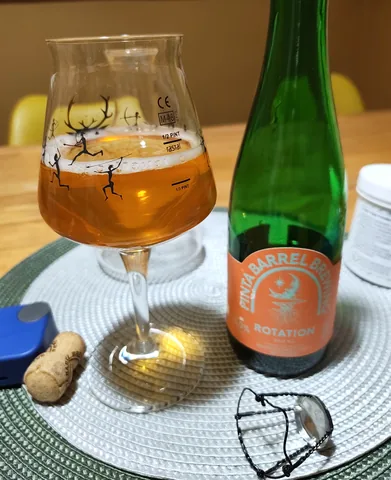 Rotation, vintage 2026.
Impression
I was quite excited about this beer, a Polish brewery with an impressive range of barrel aged, mixed fermentation beers produced using a house blend of yeasts and bacteria. Apricots are a solid addition in my experience with a flavours that carry through to the glass even in well aged beer.
The beer was well carbonated, but head retention was relatively poor. The apricot flavour and aroma was well present and worked well with the oak character, but it was the amount of acetic acid in the beer what made it not as enjoyable for me. From memory, the character matched exactly that of several beers I have made at home, which over time I have come to dislike. I appreciate this is no more than a personal preference, but nowadays I tend to prefer much lower levels of acetic acid in mixed fermentation beers than I used to tolerate and often love in the past. This beer crossed the threshold by a margin.
The beer
Researched 2026-10-18 from published sources (numbered below), not the author's own observations.
| Item | Finding |
|---|---|
| Brewing | Pilsner barley malt, rye malt and wheat flakes; a blend of aged European hops [1]. Mash, boil and IBU not public |
| Organisms | The brewery's own ("autorski") blend of wild yeasts and bacteria [1]; composition not public. The barrel brewery has a coolship tub for wild inoculation [4][5], but the Rotation page does not say it was used |
| Fermentation and ageing | Vintage 2026: 24 months in total in oak ex-wine barrels [1][3]. Vintage 2024 was 12 months [2] |
| Fruit | Fresh apricots from organic farming, 12 months on the fruit (vintage 2026) [1][3]; 5 months in vintage 2024 [2]. Rate and form not public |
| Packaging | Corked and caged; the brewery bottles in thick glass for refermentation [4]. Bottling yeast, priming and filtration not public. 6.0% ABV (vintage 2026) [1][3]; 5.2% (vintage 2024) [2] |
What it means for the bugs:
- Expect Brett and lactic bacteria from the house blend, and possibly wild yeasts from the apricots [Med].
- Acetic acid this marked points to oxygen exposure in barrel, through acetic acid bacteria or Brett; neither tells whether acetic acid bacteria survive in the bottle [Med].
- No bottling yeast is named, so a separate Saccharomyces in the dregs cannot be ruled out [Low].
- A 2026 bottle at 6.0% should still hold live Brett [Med]; after 12 months on raw fruit the dregs show only part of the house blend [Low].
Sources: 1. Rotation (vintage 2026), PINTA Barrel Brewing, 2026. 2. Rotation (vintage 2024), PINTA Barrel Brewing, 2024. 3. Rotation (2026), Untappd (producer's description), 2026. 4. PINTA Barrel Brewing, Piwne podróże, 2024. 5. Craft beer in Poland: Browar PINTA and PINTA Barrel Brewing, Craft Beer Nomads, 2022.
The bugs
Not recorded.
Decision
I did not consider exploring the organisms in this beer.