Cantillon Rosé de Gambrinus
WB-BUG-2026-020 · stage: banked · started 2025-08 (month from the slant date; exact day not recorded)
Current state
Banked as a single Brett culture, Cantillon Rosé de Gambrinus - Brett: two slants and one slurry tube. It started as two Brett cultures, Cantillon Tiny Brett and Cantillon Long Brett, kept separate for a while and recently mixed together for simplicity. The lacto was not kept.
Source
A bottle of Rosé de Gambrinus, Cantillon: a raspberry lambic (see the tasting note). A subtle beer, with the raspberry present but not dominating; that balance is why I wanted its bugs.
What else was in the bottle
Only Brett and lacto grew on the first plate from the bottle dregs. No Saccharomyces was found (see Plating and colonies).
Plating and colonies
| Colony | Round | Medium | Days | Temp (°C) | Morphology | Notes |
|---|---|---|---|---|---|---|
| Brett (tiny cells) | First plate | Wort agar | not recorded | ~21 | Lemon shaped | Picked straight to slant |
| Brett (long cells) | First plate | Wort agar | not recorded | ~21 | Elongated | First taken for Saccharomyces; Brett under the microscope. Picked straight to slant |
| Lacto | First plate | Wort agar | not recorded | ~21 | Tiny | Not picked; not kept |
| recorded |
Picking clean colonies
Isolating from this beer was straightforward, thanks to a lucky dilution. The colonies on the first plate were relatively easy to pick apart. Unlike the Shrinebuilder journey, the lacto colonies here were tiny.
Picking Brett needed care: it would be easy to scoop some bacteria at the same time, or, more likely, the colony sits over bacteria or carries it. I don't scoop full colonies; I just take a tiny bit from the top. It is not foolproof, but it helps minimise the risk. It is worth taking time under the microscope hunting for the odd bacterial cell to judge whether the sample is clean. I go over a whole slide.
Given how good the first plate was, I went directly to slant after carefully picking colonies, bypassing my own banking protocol.
Saccharomyces or Brett?
Looking at the plate, I thought I had isolated a (very slow) Saccharomyces, a Brett and a lacto on the first strike. Under the microscope, what I took for Saccharomyces appeared to be just another Brett. You can never tell for sure, but the strain behaved and looked like Brett, so Brett it is for me.
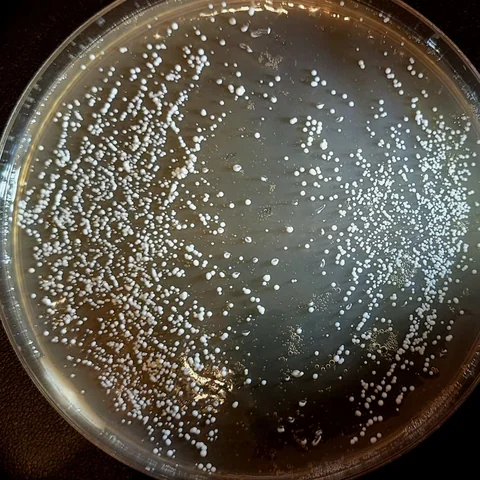 Third plating · wort agar, ~21 °C, days not recorded
Microscopy
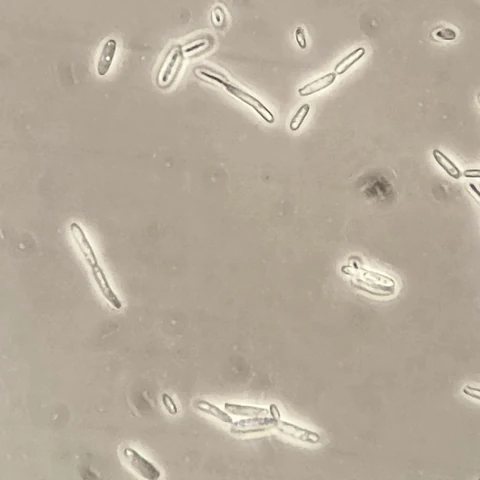 Cantillon Long Brett · 1000x oil immersion, phase contrast
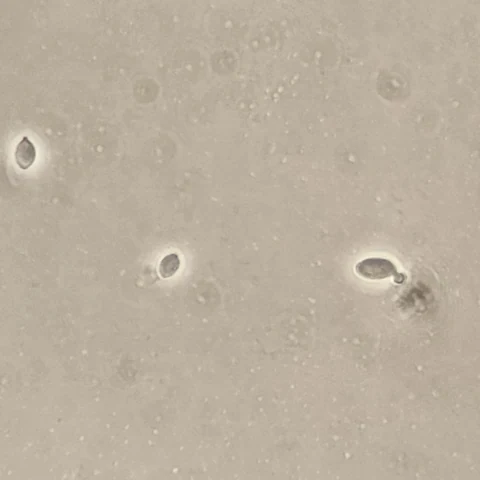 Cantillon Tiny Brett · 1000x oil immersion, phase contrast
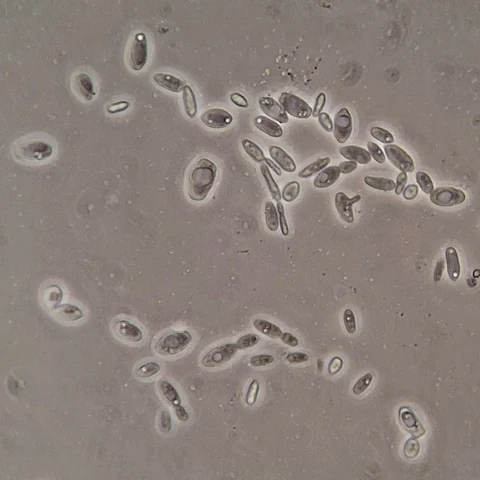 Banked culture, long and tiny Brett mixed · 1000x oil immersion, phase contrast
Outcome
- Cantillon Rosé de Gambrinus - Brett (WB-BUG-2026-006): banked. Two Brett cultures (Tiny and Long), kept separate for a while, now mixed.
- Lacto: not kept.
Log
2025-08 · Source (day not recorded)
Tasted Rosé de Gambrinus, Cantillon. Dregs plated on wort agar, ~21 °C.
2025-08 · Colonies (day not recorded)
First plate: only Brett and lacto. A slow colony type first taken for Saccharomyces was Brett under the microscope. Brett colonies picked from the top, checked over a whole slide at 1000x, and taken straight to slant, bypassing my banking protocol. Kept as two cultures, Cantillon Tiny Brett and Cantillon Long Brett. Lacto not kept.
2025-08 · Banked (day not recorded)
Two slants and one slurry tube.
Date not recorded · Third plating
Brett plated on wort agar, ~21 °C (photo only; details not recorded).
Date not recorded · Mixed
Cantillon Tiny Brett and Cantillon Long Brett mixed together for simplicity, banked as Cantillon Rosé de Gambrinus - Brett.
2026-09-23 · Write-up
Journey written up from notes. Tasting note and organism page (previously placeholders under Cantillon Gueuze) corrected to Rosé de Gambrinus.