002 — Plum frangipane¶
WB-ING-2026-002 · status: prepared · Disclaimer
Related: Maillard preparations · Skill user guide
Safety
Experimental home procedure. Read the disclaimer first.
Current state¶
Stages A2 and B cooked on 2026-09-17, without pH or Brix readings: KHCO₃ ~3.50 g to foam stop, 90 min at 121 °C. Stage D and beer contact not started. Until its Brix is known, the Stage B paste is held as a low-acid preserve: closed, ≤3 °C, added within 5 days of opening. See the log.
Date: 2026-09-17 (rev: Stage B plum raised to 300 g) · Skill: fruit-maillard-prep v5.1 · Calculator: prep_calc.py on design-002.json
0. Request summary¶
About 1 kg of generic supermarket plums, very ripe (some starting to shrivel), with very aromatic skins and soft, very sweet orange-red flesh. They will flavour one of two fully fermented bases: (a) a pale, sharp kveik + Brett beer, or (b) a Brett-only beer fermented with WLP648 (B. bruxellensis Trois Vrai) and WLP645 (B. claussenii).
Entry mode: 1, ingredients-first, with a short base-beer comparison taken from mode 3. No intake was taken because the brief gives no base-beer measurements. The brewer selected direction B, plum frangipane, on the Brett-only base.
Brewer's revision: Stage B must carry at least 300 g of plum. Set at 300 g. Stage D drops to 700 g, and the date and glycine were re-solved. Consequence: the beer-side base load now sits at the 10 meq/L warn line, which makes it the binding constraint (§4, §13).
Scale: one 4.5 L carboy. 1 kg of fruit plus the date in 4.5 L is 240 g/L, so the design is sized as fruit-forward, not the default accent. The same kilo in 20 L is 50 g/L, too thin for a plum this subtle to read.
Do this today: the fruit is on the turn. Sort it, halve and stone it, weigh the fractions, and freeze the Stage D fraction (700 g). Cook Stage B now, or freeze that fraction too. Wash and dry the stones and keep them.
1. Directions (mode 1)¶
| Thesis | Dominant mechanism | Sacrifices | Rough formula | |
|---|---|---|---|---|
| A. Plum kriek | Fresh plum skin and flesh, nothing cooked | Stage D. Brett and beer-side Lallzyme release the skin glycosides | No depth or body. Carries the most sugar and acid of the four | 1000 g D + 15 g stone (A2) |
| B. Plum frangipane (selected) | Fresh plum on top, with toasted-nut, cocoa and marzipan depth underneath | D for the aroma, a B pyrazine jar for the nutty base, A2 on the fruit's own stones for benzaldehyde | 300 g of the plum loses its fresh aroma. 4.5 g of KHCO₃ (at the beer-side warn line) and some acrylamide exposure | 700 g D + B (300 g plum, 80 g date, glycine, Phe) + 15 g stone (A2) |
| C. Plum jam (Pflaumenmus) | Stewed, jammy plum with caramel and honey | B run as a furanone jar at pH 4.4: furaneol, maltol, damascenone | Less nutty/roast. Reads more "cooked fruit" | 700 g D + 300 g plum and 80 g date at pH 4.4 (about 2 g KHCO₃) |
| D. Plum-skin tincture | The skin's free volatiles captured and dosed to taste at bottling | Stage T | Only free volatiles extract, not the bound pool. Adds ABV and a peeling job | 100 g skins in 100 mL of 40 % spirit + 900 g D |
Why B: it is the only direction that keeps most of the aromatic skins raw and also gives the beer a stable backbone (pyrazines, melanoidin body) that will still be there at 18 months. The plum's own stones supply the marzipan, which fits stone fruit.
Which base: use the Brett-only WLP648/645 beer. Both strains are low-phenol and fruity (pineapple, pear, stone fruit), so they suit a delicate plum (Med, supplier descriptions). A Brett-only beer has little acidity of its own. Plum brings about 23 meq/L of free malic acid, and with no LAB present nothing converts it, so it stays as a fresh, apple-like tartness. In the kveik + Brett "sharp" base, that same malic acid lands on a beer that is already acidic, and kveik esters compete with the skin aroma. The plum would read as extra sourness rather than as plum (Med). With no LAB there is also no arginine→ornithine THP route, and this design adds almost no Lys.
2. Formula by stage (fruit-forward, one 4.5 L carboy)¶
Every stage is listed. Rows marked n/a are not used, with the reason.
| Stage | Applies? | Material | g | Purpose, flavours and aromas |
|---|---|---|---|---|
| A1 pectin pre-treatment | n/a | – | – | Lallzyme is used beer-side instead. An A1 hold would add a warm hold for little gain on a reduced jar |
| A2 kernel hydrolysis | yes | Plum stones (shell + kernel), cracked and crushed | 15 | Kernel emulsin turns amygdalin into benzaldehyde (marzipan, cherry-almond). The vent removes most of the HCN |
| Water | 100 mL | Hydrolysis medium (5–10× stone mass) | ||
| B pyrazine jar | yes | Plum, halved and stoned, skins on (softest fruit) | 300 | Some RS, carotenoid (ionones: violet, dried apricot), plum-jam furanones |
| Medjool date, pitted | 80 | Low-asparagine reducing-sugar backbone. Brings the jar up toward the Brix band | ||
| Glycine | 1.8 | Bulk amine: alkylpyrazines (roasted hazelnut, cocoa) | ||
| L-phenylalanine | 0.5 | Phenylacetaldehyde (honey) in the jar, becoming 2-phenylethanol (rose) in the beer | ||
| KHCO₃ | 4.49 full / 3.59 first pass | Moves the jar into the pyrazine branch at pH 6.15 | ||
| Phosphoric acid 85 % | 0 | Not inverting (see §4) | ||
| Rehydration water | 0 | No dried material to rehydrate. The date is used as is | ||
| C phenolic jar | n/a | – | – | Plum is only moderately polyphenolic. The skins' tannin and colour stay in D |
| D raw fruit into beer | yes | Plum, halved and stoned, skins on, frozen then thawed | 700 | Fresh plum. The glycoside-bound skin aroma (linalool, benzaldehyde, lactones, norisoprenoids) is released by Brett and Lallzyme. Also acidity and pink-red colour |
| + vented A2 slurry | (from A2) | Marzipan, added post-primary | ||
| T tincture | n/a | – | – | Not needed at this fruit dose. See the tweak points |
| Beer-side | yes | Lallzyme Beta | 0.225 | 50 mg/L, added once the fruit sugar has fermented. Frees the bound aroma and clears pectin haze |
| Bottling | yes | EC-1118 | usual | Standing practice. Clean-up and protective SO₂ |
Stoned fruit total: 1000 g. Stage B is fixed at 300 g, so if the stones leave less than 1000 g of flesh, cut Stage D, not Stage B.
3. Nitrogen¶
- Glycine 1.8 g (23.9 mmol), Phe 0.5 g (3.0 mmol), collagen 0 g. No protease step.
- Reactive amine 27.0 mmol against 68.4 g RS gives a sugar:amine ratio of 14.1:1. The jar is glycine-only, so the 10:1 rule does not apply. The ratio sits at the top of the preferred 10–14:1 band.
- Glycine was held at 1.8 g, not raised to 2.0 g: 2.0 g gives 12.8:1 but pushes added FAN to 30 mg N/L and trips the warning.
- Protein carried in: 1.6 g, from the date. Lys+Arg 29 mg.
4. Base dose (Stage B only)¶
This is the binding constraint in this revision. Doubling the Stage B plum doubles its malic acid. The base needed to reach pH 6.15 nearly doubles with it, and lands on the beer-side warn line (§13).
- Native pH of the mixture: 3.2 (Low). This is estimated from the table row for plum (malic, pH 3.2, TA 15 meq/100 g) and date (pH 5.8, which falls back to the unanchored estimate). Very ripe plums probably sit higher, around pH 3.4–3.6 with TA 8–12. Measure it.
- TA in the jar: 47.4 meq. Target pH 6.15, cold.
- Full dose 4.49 g KHCO₃ (44.9 meq). Effective factor 0.95 of the fruit's TA.
- First pass: 3.59 g, added in 3 portions (it foams hard at this dose). Stir, measure cold with the spear probe, then titrate the rest in to 6.15. Record predicted against measured.
- If the fruit is riper (RS 9, Suc 4, TA 10, pH 3.5), the solve gives 3.05 g full / 2.44 g first pass and a beer-side load of 6.8 meq/L. The meter decides.
- If the titration needs more than 4.5 g, stop at pH 6.0 rather than 6.15. Record it, and accept a slightly more mixed-band cook rather than going over the warn line.
- No inversion and no phosphoric acid. The B plum carries about 9 g of sucrose, and acid-dosing it would cost further base on a jar that is already at the limit. That sucrose is still counted as fermentable in the beer.
- Stage C is not used, so there is no unbased-jar question.
5. Ingredients list¶
| Item | Needed | Buy / check |
|---|---|---|
| Plums | 1000 g stoned (in hand) | Discard any with mould, brown rot (Monilinia), split or weeping skin, or a fizzy/alcoholic smell. Shrivelled is fine. Wash |
| Plum stones | 15 g | From the same fruit |
| Medjool date | 80 g pitted | Buy about 95–100 g whole. Medjool-type, no added sugar or oil coating |
| Glycine | 1.8 g | Held |
| L-phenylalanine | 0.5 g | Buy if not yet held (food/supplement grade) |
| Potassium bicarbonate | 4.5 g (+ margin) | Held |
| Lallzyme Beta | 225 mg | Held. Weigh it dry on the 1 mg scale |
| EC-1118 | bottling dose | Held |
| Rehydration water | 0 g total | No dried ingredients to rehydrate |
| A2 water | 100 mL | Tap water, boiled and cooled |
Not needed: phosphoric acid, collagen, papain, shiitake, spirit, almond, oak.
Vessel trap: 4.5 L of beer plus 700 g of fruit, the B paste and the A2 slurry come to about 5.4 L, before any foam from about 30 g/L of fresh sugar. That will not fit a 5 L carboy. Do the fruit contact in a 7–8 L wide-neck vessel or bucket with an airlock, then rack back into the 5 L carboy.
6. Cook and process¶
Measure first: read the plum juice on the brewing refractometer (°Brix) and take its native pH. Both feed the sugar and base figures.
A2 (plum stones):
- Crack and crush 15 g of stones, then cover with 100 mL of water.
- Hold 2 h at 40–50 °C. Kernel slurry is low-acid (about pH 5.5), so 2 h is the maximum.
- Vent 10 min uncovered just below the boil, stirring.
- Smell check: the water should smell strongly of bitter almond, and the drained kernel much less so.
- Cool, cover and use the same day.
Stage B:
- Crush 300 g of plum with 80 g of chopped date (380 g total) and measure the native pH.
- Optional, to shorten the hob time: dry the 300 g of plum halves first in a low oven (about 70–80 °C) and weigh off up to 150 g of water.
- Reduce on the hob, uncovered, at native pH, stirring, in a wide pan. Up to about 250 g of water comes off (an upper bound), so expect 45–75 min and stir hard towards the end: this volume scorches easily. Stop when the refractometer reads about 60–62 °Brix; the base and amino acids then add a few points. Expect a paste of about 130 g.
- Cool below 40 °C. Stir in the glycine, the Phe and 3.59 g of KHCO₃ in three portions, then measure pH cold and titrate to 6.15 (see the §4 cap).
- Read the Brix again: it must be 60–68 before sealing (never above 72). Never seal a based jar below 60 °Brix.
- Fill a clean ~150 mL jar to 85–90 % (10–15 % headspace). Lid finger-tight.
- Stand the jar in 3–5 cm of water in the pressure cooker. 121 °C, 105 min from full pressure.
- Let the pressure release naturally. Open the jar while hot and hot-vent it for 5–10 min, stirring, then re-lid and slow-cool on the bench. The slow cool is safe because a_w ≤0.86.
- The jar keeps on water activity. Use it within days.
Stage C: none. There is no fast-cool or fridge step to schedule.
Beer-side sequence:
- Day 0: thaw the 700 g of Stage D fruit. In the large vessel, add the fruit, the B paste (loosened in a little beer) and the A2 slurry, then rack 4.5 L of the fully fermented Brett-only beer onto them. Hold at 20–22 °C.
- When gravity is back near terminal (probably 2–4 weeks with Brett only), add 225 mg of Lallzyme Beta and leave on the fruit for another 2–4 weeks.
- Rack off the fruit into the 5 L carboy.
- Gravity gate: a stable reading taken twice, 4–6 weeks apart. Then bottle with EC-1118.
- Store the bottles dark, because they carry kernel material.
7. Predicted compound inventory¶
| Stage | Axis | Compounds | Sensory |
|---|---|---|---|
| A2 | Marzipan | benzaldehyde | bitter almond, cherry-stone, Bakewell |
| B | Nut / cocoa | 2,5-dimethylpyrazine, trimethylpyrazine, 2-ethyl-3,5-dimethylpyrazine (glycine-led) | roasted hazelnut, cocoa, toast |
| B | Honey | phenylacetaldehyde | honey, hyacinth |
| B | Caramel / jam | furaneol, maltol, cyclotene. The larger plum share and the drift pull more of the late cook into the mixed band | strawberry-caramel, plum jam, candyfloss. More jammy than rev 0 |
| B | Carotenoid | β-ionone, trace β-damascenone (doubled plum means doubled carotenoid) | violet, dried apricot, stewed apple |
| B | Body | melanoidins | brown colour, rounder palate, faint bitterness |
| B | Polyphenol | plum-skin flavanols trap some dicarbonyls | slightly less pyrazine per gram of sugar than a date-only jar (Med) |
| D | Fresh plum | free and glycoside-released linalool, geraniol, benzaldehyde, γ-/δ-lactones, C6 notes | plum skin, blossom, peach-skin, green-almond |
| D | Acid | malic acid | crisp, apple-like tartness |
| D (in beer) | Norisoprenoids | β-damascenone from carotenoid and precursors, acid-driven over months | honey, baked apple, dried plum |
8. Survives vs destroyed (18 months)¶
- Survives: alkylpyrazines (nut/cocoa undertone), furanones (jammy caramel; furaneol partly reduced over a long secondary, Med), melanoidin body, β-damascenone and β-ionone (these rise with time), malic tartness (no LAB present).
- Transformed: phenylacetaldehyde becomes 2-phenylethanol (rose), with some honey held as bisulphite adducts after EC-1118. Plum linalool and geraniol become α-terpineol and citronellol under Brett: softer, tea-rose floral.
- Fades: the fresh-cut plum top note fades after 6–12 months, and it starts weaker than in rev 0 because only 700 g goes in raw. Benzaldehyde is clear at 6 months and background at 18 (Med).
- At 18 months: plum-cake and baked-plum character on a hazelnut-cocoa base, with rose-honey and a light almond finish. Weighted more towards cooked plum than rev 0.
9. Fusel, methionol, 2-PE, FAN, THP¶
| Item | Value | Threshold / warn | Status |
|---|---|---|---|
| Isoamyl added | 0.3–0.7 mg/L | warn >25 | ok |
| All BCAA fusels | 0.8–1.6 mg/L | – | ok |
| Methionol added | 0.04–0.08 mg/L | warn >0.5 (midpoint) | ok |
| 2-PE added | 21.5–43 mg/L | useful band 40–100 | low to useful. See tweaks |
| FAN added | 28 mg N/L | warn >30 | ok, but close: expect renewed Brett activity |
| Lys+Arg carried | 29 mg | – | trivial. No collagen |
10. Kernel calculation¶
Unchanged from rev 0.
- A2 run on 15 g of plum stone (planning figures: ~1 mg/g benzaldehyde, 0.25 mg/g HCN, Med).
- Assumed completeness 0.70 gives an effective HCN retention of 0.58.
- Benzaldehyde potential 3.33 mg/L. After the vent and post-primary survival: 1.9–2.3 mg/L in the beer (threshold 0.5–2, cloying >5). In range.
- HCN 0.18 mg per 375 mL bottle: 12.9 % of the ARfD for one bottle, 25.9 % for two. The 50 % warn point is reached at about 58 g of stone.
- Route: D, post-primary. Ethyl carbamate: store the bottles dark.
11. Colour and body¶
The B paste (about 29 g/L of dark-brown melanoidin, up from 24) moves a pale base several SRM darker, towards amber-copper. The D skins add pink-red anthocyanin, which will partly fade to rose-copper, faster with Lallzyme's pectinase side activity. Expected result: hazy copper-rose, darker than rev 0. The pectin haze should mostly clear after Lallzyme. The body is rounder from the melanoidins and the residual sorbitol (not fermentable).
12. Fermentable load¶
| g/L | ΔABV | |
|---|---|---|
| Planned (25 % of B RS reacted) | 27.8 | +1.79 % |
| Worst case (none reacted, all sucrose) | 31.6 | +2.04 % |
| Riper fruit (RS 9, Suc 4) worst case | 40.4 | +2.61 % (Low) |
The load is above 10 g/L, so add early (the beer is already fully fermented, so add now) and hold the gravity gate absolutely. Everything here goes in well before bottling, so nothing falls outside the gate. No Stage T, so no tincture ABV.
Dose anchors: Stage B concentrate 29 g/L (fruit-forward ≤60), total fruit 240 g/L (200–400). Both inside.
13. Beer-side acid, potassium, FAN¶
- Base carried in: 45 meq (10.0 meq/L), at the warn line. On its own that would raise pH by about 0.25–0.50 units. This is the cost of the 300 g Stage B requirement. The mitigations are the §4 cap, riper fruit (6.8 meq/L), or the furanone variant (tweaks).
- Free malic acid from Stage D: 23.3 meq/L, pulling the other way and larger. Net result: still more acidic than the base beer, but less sharpened than rev 0, with more potassium-malate buffer (Med on magnitude).
- K⁺ added: 390 mg/L (warn >500). Below the warn, but perceptibility as saline or soft is possible at the upper end in a low-ionic Brett beer (Med).
- FAN added: 28 mg N/L.
- MLF: malate is a substrate, but there is no LAB in the Brett-only base, so it stays.
14. Safety, warm hold¶
| Hold | Duration | pH class | Enters beer uncooked? |
|---|---|---|---|
| A2 stones in water, 40–50 °C | ≤2 h | low-acid (~5.5) | No. Vented just below the boil |
| Optional low-oven pre-dry of B plum | 70–80 °C (above the growth range) | acidic | No. Cooked at 121 °C |
| Stage B | none (hob reduction at the boil) | acidic, then based after reduction | No. Cooked at 121 °C |
| Stage D | none. Frozen then thawed cold | acidic (3.2–3.6) | Yes, raw, no hold, no enzyme on the fruit |
No uncooked material is held warm below 60 °C. Lallzyme goes beer-side only. Stage B Brix is confirmed at 60–68 before sealing. Fruit selection is the patulin and brown-rot control.
15. Safety, compounds¶
- Acrylamide: glycine present (a competing amine, which helps). The asparagine-rich plum is now 79 % of the jar's fruit mass, which weakens the date-backbone lever relative to rev 0. pH 6.15 is the unfavourable band; the lever is the furanone-jar variant. Paste is about 130 g, so the exposure is roughly 6–12 µg per bottle at most (Low).
- Furan: plum is not ascorbate-rich. The B jar is hot-vented for 5–10 min. The A2 slurry is vented for 10 min.
Confidence¶
| Claim | Tag |
|---|---|
| Plum RS/Suc/TA/pH for this very ripe fruit | Low: measure Brix and pH |
| Base dose arithmetic | High. Absolute pH Med |
| Beer-side pH rise from 10 meq/L | Med (buffer capacity assumed) |
| Plum-stone benzaldehyde/HCN per gram (whole stone) | Med |
| A2 completeness 0.70 | Med-low |
| Pyrazine yield at 121 °C with a plum-heavy B jar (plum-skin suppression) | Med-low |
| 25 % of B RS reacting | Med. Plan on the worst case |
| Brett-only base as the better match | Med |
| Brett β-glucosidase contribution without Lallzyme | Low (strain-dependent) |
Tweak points¶
- Drop the potassium and acrylamide (plum-jam direction): run B at pH 4.4 as a furanone jar, keeping 300 g of plum. KHCO₃ falls to about 2 g (recompute) and the beer-side load to about 4.5 meq/L. The flavour turns jammy and caramel rather than nutty. This is the cleanest fix for the §13 warn-line load.
- Push pyrazines harder: extend the cook to 120 min, or run the §1 paired roast-finish jar (135–140 °C, 20 min, covered). Phosphoric inversion is not recommended here: it would add base on a jar already at the limit.
- Protect the florals: add a small Stage T of plum skin (20–40 mL dosed at bottling) to restore the fresh top note that the smaller D fraction gives up.
- More marzipan: raise the stone to 25 g. Benzaldehyde about 3.1–3.9 mg/L, HCN about 0.30 mg per bottle (22 % / 43 % ARfD). Do not go past 40 g.
- More rose-honey: raise Phe to 1.0 g, giving about 43–86 mg/L of 2-PE (+~2 mg N/L FAN, still under 30).
- Cut the sugar load: reduce D to 400 g. That gives about 173 g/L total, between the two archetypes, and about 25 g/L worst-case fermentable.
Log¶
2026-09-17 · Designed¶
Design intaken from design-002-plum-frangipane.md.
2026-09-17 · Prepared: Stages A2 and B cooked¶
Cook log intaken from design-002-plum-frangipane-cook-log.md.
Date: 2026-09-17 · Design: design-002-plum-frangipane.md (rev: 300 g plum in Stage B) · Skill: fruit-maillard-prep v5
Status: Stages A2 and B cooked; Stage D and beer contact not yet started. Everything below is cook-time evidence only. Beer-side predictions stay open until tasting, and an open batch is not evidence.
1. Brewer's notes (as given)¶
Stage A2: "Mild agreeable bitter almond, cherry stone. I cannot see how this will be enough for 4.5 L, perhaps I should have crushed the pits to smaller pieces."
Stage B: "Very deep and complex aroma. All what you predicted, though non-discernible honey and hyacinth. Hot bun, bready, treacle, Christmas pudding, dark caramel, faint bitterness that clears into a bright plum and strawberry caramel. Complex."
Process, as run:
- No pH meter and no refractometer used.
- Stage B reduced by eye to a very thick, jam-like consistency.
- KHCO₃ added slowly, about 3.50 g in total, until the mixture no longer foamed.
- Cooked 90 min at full pressure.
- Pressure left to equalise naturally, then 30 min more before the cooker was opened. The jar was then opened and vented by stirring with a spoon.
Photos¶
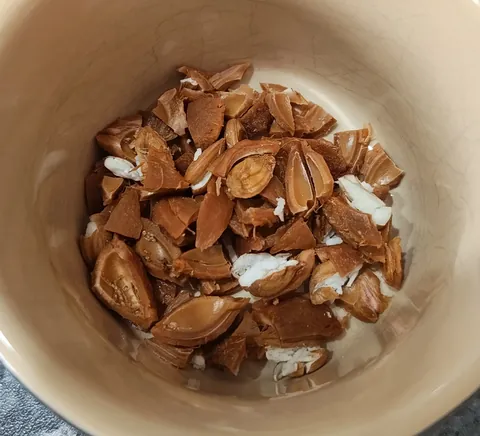 Stage A2: how the stones were cracked (coarse pieces) · 2026-09-17
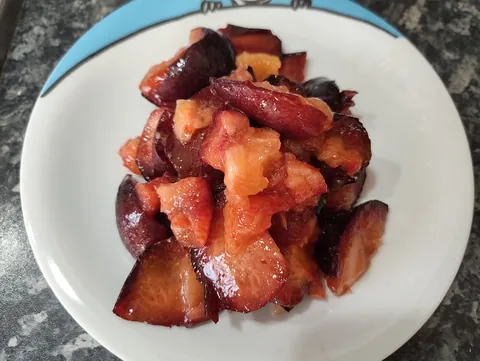 Stage B: the 300 g of plum going into the cook, for colour and consistency · 2026-09-17
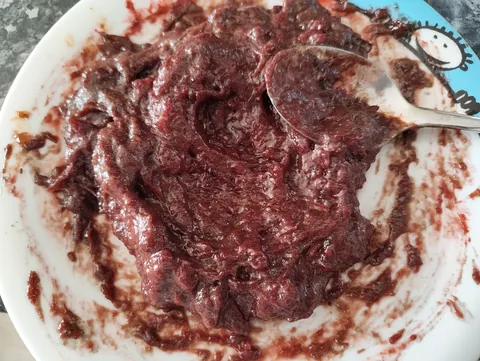 Stage B: the paste with all ingredients mixed, before the pressure cook · 2026-09-17
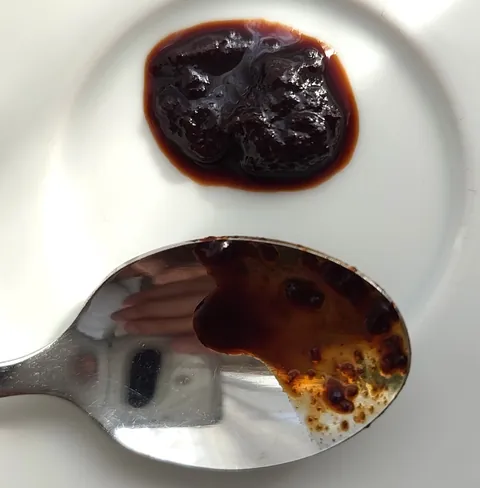 Stage B after the cook: colour and texture · 2026-09-17
2. As run vs design¶
| Parameter | Design | As run | Consequence |
|---|---|---|---|
| A2 stone, g | 15, cracked and crushed | 15 (assumed), coarse pieces | Incomplete hydrolysis likely (§3) |
| A2 hold / vent | ≤2 h at 40–50 °C / 10 min sub-boil | as design (assumed) | – |
| B plum / date / glycine / Phe | 300 / 80 / 1.8 / 0.5 g | as design (assumed) | – |
| Native pH | measure (est. 3.2) | not measured | Base dose unanchored |
| KHCO₃ | 4.49 g full, 3.59 g first pass, titrate to 6.15 | ~3.50 g, to foam stop | Final pH unknown. Estimated 5.3–7+ (§3) |
| Brix at seal | 60–68, read | not read. "Very thick, jam-like" | Stage B a_w hurdle unconfirmed |
| Paste mass | ~130 g | not recorded | Weigh it now (§6) |
| Cook | 121 °C, 105 min | 121 °C, 90 min | Low end of the 90–120 band |
| Cooling | natural release, hot vent 5–10 min, slow cool | natural release +30 min closed, then spoon-stir vent | Longer 60–100 °C dwell. Vent done cooler |
| Headspace / lid | 10–15 %, finger-tight | as designed | – |
3. Can the process explain the outcome?¶
Base to foam stop (3.50 g): yes, most likely the main driver¶
Foam stopping means the free acid strong enough to release CO₂ from bicarbonate has been used up. That places the endpoint somewhere around pH 5.5–6.5, and a thick paste traps CO₂ and suppresses foam, so the reading is blurred further. Foam stop is not a pH endpoint (Low as a proxy).
What 35 meq does under the design's own solve, depending on the fruit's real acidity:
| Plum assumption | TA, meq/100 g | Native pH | Base for 6.15 | pH reached with 3.50 g |
|---|---|---|---|---|
| Table row | 15 | 3.2 | 44.9 meq | ~5.3 (mixed / furanone band) |
| Intermediate | 12 | 3.4 | 36.2 meq | ~5.9 (mixed, near target) |
| Very ripe | 10 | 3.5 | 30.5 meq | >7 (fruit buffer exhausted; free bicarbonate holds it around 7–8) |
The observed profile points to the lower-middle row. The two strong observations, bready/hot bun, treacle, dark caramel, Christmas pudding and bright plum/strawberry caramel, are the furanone, maltol and caramel family that dominates at pH 5–6 and that drift pushes further (chemistry.md §4). A strong overshoot above 7 would have given acrid, pyridine-harsh notes, and only a faint bitterness that clears was reported. So the jar most probably ran in the mixed band, not the pyrazine band (Med-low). That also fits the nut/cocoa axis reading as "bready" rather than as hazelnut or cocoa.
Reduction by eye ("jam-like"): partly¶
Plum is pectin-rich, so it sets jam-thick below 60 °Brix. The paste may have been anywhere from about 50 to 70 °Brix (Low). A wetter jar means slower Maillard and relatively more furanone and caramel. A drier one means more caramelisation and darker notes. Neither changes the call above. Safety: the Stage B a_w hurdle cannot be confirmed. 90 min at 121 °C gives a large F₀ in a small jar (High), so spores are not the issue. The residual risk is after opening, so the paste must be treated as a low-acid, possibly high-moisture preserve (§6).
90 min instead of 105: minor¶
This is inside the 90–120 band. Conversion is slightly lower, leaving a little more unreacted glycine and sugar in the beer. It does not explain the flavour profile.
Extra 30 min closed, cooler vent: minor, and in the direction observed¶
A longer dwell at 60–100 °C continues Amadori decomposition and caramel development, so it adds to the dark caramel and treacle notes. Venting cooler removes less furan, although furan (bp 31 °C) still leaves readily at 60–80 °C, so this is Med on adequacy. Neither explains the missing honey.
Honey/hyacinth not discernible¶
Three causes, none of them process errors:
- 0.5 g of Phe is the bottom of the range.
- Phenylacetaldehyde is masked by the dark caramel and dried-fruit notes.
- The plum-skin flavanols trap dicarbonyls, which lowers the Strecker yield.
Its designed job was 2-phenylethanol (rose) in the beer, which is still open.
A2 mild¶
None of the Stage B process points apply. The cause is coarse crushing: amygdalin and emulsin sit in the kernel, which is roughly 10–15 % of the stone's mass (Low), and shell fragments keep water out. The consequence is incomplete hydrolysis, so un-hydrolysed amygdalin will be released by Brett in the bottle. At 15 g of stone this stays under the ARfD warn line even at zero completeness: 0.31 mg HCN per bottle, 22 % ARfD for one bottle and 45 % for two.
4. Cook-time verdict vs prediction¶
| Predicted (design §7) | Observed | Verdict | Most likely mechanism |
|---|---|---|---|
| A2: benzaldehyde, clear marzipan (slurry ~100 mg/L) | mild bitter almond, cherry stone | Partial | Coarse crush, low A2 completeness |
| B: jam / strawberry-caramel furanones | bright plum and strawberry caramel | Hit | Furaneol, favoured by the mixed band |
| B: melanoidin body, faint bitterness | dark caramel, faint bitterness that clears | Hit | – |
| B: more jammy than rev 0 | Christmas pudding, jammy | Hit | – |
| B: roasted nut / cocoa / toast from pyrazines | hot bun, bready, treacle; no nut or cocoa named | Partial, right family for the wrong reason | Probably ran below pH 6 (§3). Pyrazine share lower, furanone/maltol/caramel share higher. Possibly some date proline → bread-crust notes (Low) |
| B: honey / hyacinth from Phe | not discernible | Miss (at cook) | Low dose, masking, polyphenol trapping |
| B: carotenoid ionones (violet, dried apricot) | not reported | Unresolved | Possibly under the dark notes. Check in the beer |
5. Batch-log block¶
For data/batch-log.md, as the next entry after 001. [later] fields are left blank where nothing is known yet.
## 002 - Plum frangipane: raw plum D + plum/date pyrazine B + A2 plum stone - 2026-09-17

**Target:**                          fresh plum top note over a toasted-nut / cocoa / caramel base with
                                     marzipan; fruit-forward (240 g/L total fruit), 4.5 L, Brett-only
                                     base (WLP648 + WLP645), fully fermented
**Stages used:**                     A2, B, D, beer-side Lallzyme, EC-1118 at bottling. A1 skipped
                                     (Lallzyme used beer-side instead); C skipped (plum only moderately
                                     polyphenolic); T skipped (not needed at this fruit dose)
**Formula (per 4.5 L target):**      A2: 15 g plum stone, cracked, in 100 mL water.
                                     B: 300 g very ripe supermarket plum (stoned, skins on), 80 g Medjool
                                     date, 1.8 g glycine, 0.5 g L-Phe, KHCO3 (design 4.49 g; used ~3.50 g).
                                     D: 700 g same plum, stoned, skins on, frozen/thawed.
                                     Beer-side: Lallzyme Beta 225 mg after the fruit sugar ferments.
                                     x4.4 for 20 L
**Sizing check:**                    Stage B concentrate ~29 g/L (fruit-forward <=60); total fruit 240 g/L
                                     (200-400). Inside
**Nitrogen:**                        glycine 1.8 g / Phe 0.5 g / collagen 0 / other none; no protease step;
                                     sugar:amine 14.1:1 molar (68.4 g RS : 27.0 mmol); 10:1 rule n/a
                                     (glycine-only)
**Protein load:**                    ~1.6 g (date); Met negligible
**Native pH:**                       est. 3.2 (table row, Low); very ripe fruit likely 3.4-3.6.
                                     Measured: not measured
**Base:** 4.49 g KHCO3 against 47.4 meq in the jar (design), native-pH-anchored solve (native 3.2,
                                     malic, effective factor 0.95). 80% first-pass dose: 3.59 g.
                                     Target pH: 6.15.
                                     pH measured at first pass: not measured.
                                     Final KHCO3: ~3.50 g, added to foam stop, no pH reading.
                                     Estimated final pH 5.3-7+ depending on the fruit's real TA;
                                     sensory evidence suggests ~5.3-6.0 (Med-low)
**Inversion:**                       none (design); none used
**Cook:**                            A2: <=2 h at 40-50 C, low-acid (~5.5), vented sub-boil.
                                     B: reduced on the hob at native pH to "very thick, jam-like" (Brix NOT
                                     read; design 60-68); paste mass not recorded (design ~130 g);
                                     headspace not recorded; 121 C, 90 min from full pressure (design 105);
                                     natural release + 30 min closed; vented by spoon-stirring on opening
                                     (cooler than designed); slow cool. No Stage C
**Fusel, FAN & THP budget:**         isoamyl +0.3-0.7 mg/L; methionol +0.04-0.08 mg/L; 2-PE +21.5-43 mg/L;
                                     added FAN 28 mg N/L (warn 30); Lys+Arg 29 mg; no warns
**Kernel calculation:**              A2 run, crush COARSE. Planned completeness 0.70 -> retention 0.58 ->
                                     0.18 mg HCN/375 mL (12.9% ARfD; 25.9% for two). Given the coarse crush:
                                     completeness 0.3 -> 0.26 mg (18% / 37%); worst case 0 -> 0.31 mg
                                     (22% / 45%). Benzaldehyde planned 1.9-2.3 mg/L post-primary via D;
                                     likely lower at cook. Store dark
**Beer-side:**                       fermentable planned 27.8 g/L, worst case 31.6 g/L (riper fruit up to
                                     ~40 g/L); dABV +1.8 / +2.0% (up to +2.6%); gravity gate absolute, all
                                     additions pre-gate; no tincture. Base as run ~35 meq = 7.8 meq/L
                                     (design 10.0) -> beer pH +0.2-0.4 on its own; free malic from D
                                     23.3 meq/L pulling the other way; K+ ~304 mg/L as run (design 390);
                                     colour: pale -> hazy copper-rose, several SRM darker
**S21 compliance:**                  A2 <=2 h, low-acid; no other warm hold; nothing held warm enters the
                                     beer uncooked. Stage B Brix NOT confirmed before seal. Paste to be
                                     held <=3 C and used within 5 days, or added now
**S22 line:**                        glycine present; B pH probably ran mixed band (lower acrylamide than
                                     designed); plum-heavy (asparagine) backbone; hot vent done late and
                                     cooler than specified
**Predicted:**                       Cook: furanone plum-jam / strawberry caramel, alkylpyrazine hazelnut /
                                     cocoa / toast, phenylacetaldehyde honey, melanoidin body with faint
                                     bitterness, ionone violet / dried apricot; A2 clear marzipan.
                                     Beer 6 mo: fresh plum skin and blossom (D, Lallzyme), malic tartness,
                                     marzipan 1.9-2.3 mg/L, nut/cocoa undertone, rose (2-PE), hazy
                                     copper-rose.
                                     Beer 18 mo: plum cake / baked plum, hazelnut-cocoa, rose-honey,
                                     damascenone baked apple, marzipan in the background; fresh plum faded.
                                     Survives: pyrazines, furanones (part), melanoidins, norisoprenoids,
                                     malic (no LAB)
**Confidence flags to check:**       plum RS/TA/pH (Low); pyrazine yield in a plum-heavy jar (Med-low);
                                     A2 completeness (Med-low); Brett glycosidase without Lallzyme (Low);
                                     beer pH rise from base (Med); foam-stop as a base endpoint (Low)

**Actual, at cook:**                 Brix: not read ("very thick, jam-like"). pH: not measured at any point.
                                     KHCO3 ~3.50 g to foam stop. A2: mild bitter almond, cherry stone,
                                     judged too weak for 4.5 L. B: very deep, complex; hot bun, bready,
                                     treacle, Christmas pudding, dark caramel; faint bitterness clearing
                                     into bright plum and strawberry caramel; honey / hyacinth not
                                     discernible; nut / cocoa not named. Colour and texture: [later]
**Added to:**                        [later]
**Actual, in beer at N months:**     [later]
**Verdict vs prediction:**           At cook: A2 partial (coarse crush). B furanone / caramel hit; body /
                                     bitterness hit; jammy hit; pyrazine nut / cocoa partial (bready
                                     instead; probable sub-6 pH); honey miss; ionones unresolved.
                                     Beer-side: [later]
**pH calibration:**                  no measurement - not a calibration point
**Reference corrections:**           none yet (cook-time only, unmeasured). See the candidates below
**Change next time:**                [later] - provisional: measure native pH and dose to a reading, not
                                     to foam stop; read Brix before sealing; crush stones to grit or
                                     use kernels only; Phe 1.0 g if honey is wanted at cook
6. Open actions¶
- Data you can still get:
- Weigh the Stage B paste (jar gross minus tare) for the paste-mass field.
- A cold pH of the cooked paste is still useful. It reads after the drift, so it is a lower bound on where the jar started, but it tells us which row of §3 you were on.
- A Brix reading of the cooked paste is also still valid, and it settles the a_w question.
- Stage B storage: until the Brix is known, treat it as a low-acid preserve. Keep it closed at ≤3 °C and add it to the beer within 5 days of opening.
- A2: bench test first, 1 mL of slurry in 45 mL of base beer. If it is short:
- Strain the slurry and keep the liquid. Discard the coarse solids.
- Run a fresh A2 on kernels only, ground to a paste.
- Report the kernel mass and the number of stones before dosing, because kernels carry about 7–10× the whole-stone amygdalin per gram (Low) and HCN must be recomputed.
- At the Stage D addition: record the date, the actual D mass, and the paste and slurry masses added.
7. Candidate reference corrections (not yet evidence)¶
Hold these until the beer-side debrief:
process-inputs.md, KHCO₃: add that foam stop is not a pH endpoint in a reduced paste. It can sit anywhere from about 5.3 to above 7 depending on the fruit's TA (Med).chemistry.md§17 /ingredients.mdkernel rows: state that the per-gram figures are whole stone, that A2 needs the kernel exposed and crushed to grit, and that a kernels-only A2 is dosed on kernel mass (Med).- Keep watching whether a plum-heavy, sub-6 Stage B reads as "bready / treacle" instead of "nut / cocoa". If the beer confirms it, it is a line for
ingredients.md(plum) and forchemistry.md§4.