Boon Oude Gueuze: tasting note
Tasted 2025 (year approximate) · done
Isolated
- Isolate: Boon Gueuze - Brett and Boon Gueuze - Sacch, both banked; Boon Oude Gueuze journey.
- Why: This beer shows clearly how the hops bitterness plays a significant role in funk perception.
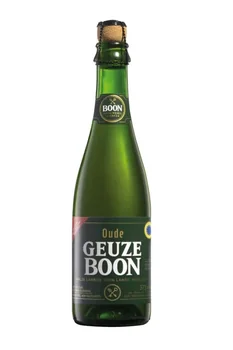 Bottle.
Impression
This is one of the first Gueuze beers I tried after spotting it in one of the bigger Waitrose supermarkets around me. I wasn't particularly fond of it initially, but over time I started to enjoy it more and more. This beer shows clearly how the hops bitterness plays a significant role in funk perception. Dry with assertive bitterness and pronounced funk.
The beer
Researched 2026-11-07 from published sources (numbered below), not the author's own observations.
| Item | Finding |
|---|---|
| Brewing | 60% malt, 40% unmalted wheat [1][3]; a high rate (about three times a normal beer) of three-year-old English and Styrian Goldings, most of their bitterness gone [4]. Mash method and boil length not public |
| Organisms | Spontaneous: wort at least six hours in an open coolship, brewed in winter only [4]. In a 2013 interview the brewery cited Leuven research naming Brettanomyces bruxellensis and B. lambicus as the main yeasts [4]. General lambic succession: Saccharomyces and Pediococcus damnosus from month 2, B. bruxellensis replacing Saccharomyces from month 6 [5] |
| Fermentation and ageing | One to three years in old oak casks and foeders [1][3]; 117 foeders of 13 to 113 hL in 2013 [4] |
| Blending | Producer: 1, 2 and 3 year old lambic [1]. Lambic.Info: 90% 18-month, 5% three-year and 5% young lambic [2]. A 2013 interview: 18-month, one and two year, a little three-year [4] |
| Packaging | Unfiltered, unsweetened; bottle-conditioned for several months after bottling [1][2]. No source names an added bottling yeast or pasteurisation. 7% ABV [1] |
What it means for the bugs:
- Brett should dominate the dregs; in a 2024 study of gueuze refermenting in the bottle, B. bruxellensis reached about 99% of the yeast at two years [6] [Med].
- The young lambic brings active Saccharomyces for refermentation, so a Saccharomyces from these dregs is plausibly the brewery's own flora rather than a bottling strain [Low].
- Bacteria fade quickly in the bottle [6]; little chance of recovering them from an aged bottle [Med].
Sources: 1. Oude Geuze Boon, Brouwerij Boon. 2. Oude Geuze Boon, Lambic.Info. 3. Brouwerij Boon, Lambic.Info. 4. No Boon of contention in classic lambic brewery, Protz on Beer, 2013. 5. The Microbial Diversity of Traditional Spontaneously Fermented Lambic Beer, Spitaels et al., PLoS ONE, 2014. 6. Refermentation and maturation of lambic beer in bottles, Bongaerts et al., Applied and Environmental Microbiology, 2024.
The bugs
Given I could get hold of this beer early on during my experiments with yeast, I decided to attempt isolating the bugs. This was long ago so I don't have many photos or details for the journey, but I did manage to separate saccharo and brett from it. I have never used the saccharo, but if I recall correctly, a mini beer showed it was a POF+ yeast much like the strains I usually ferment with. The brett on the other hand, I have used multiple times with great success. This is one of three brett strains I have that deliver a distinct character. Boon Brett accentuates hops, making the hops to come across as hop-funk which makes total sense, as this is exactly the character in the commercial beer.
The full story is in the journey.
Decision
Isolated: Boon Gueuze - Brett and Boon Gueuze - Sacch.