Shared Wort, Ester-Forward, Funk-Forward Protocols¶
Version 1 · Disclaimer
Safety
Experimental home procedure. Read the disclaimer first.
Working protocols for the G30 (25 L → ~6 × 4.2 L).
1. Wort design rationale (applies to both protocols)¶
- Turbid pulls lock in oligosaccharides (long Brett active phase → more cumulative VPR output), high-MW/proline-rich protein (Brett-specific nitrogen depot FAN can't replicate), and wort lipids (MCFA ester precursors — boil/trub removal strips up to 85% of wort fatty acids).
- 60 min boil, no finings, minimal whirlpool, generous trub carry-through — all preserve the precursor fraction. Counter-intuitive but mechanistically correct for this style.
- Nutrients: organic nitrogen only (nutritional yeast, yeast hulls); DAP suppresses ester formation and drives fast bland attenuation. Delay first addition to day 2–3 so Sacch starts slightly stressed and leaves more for Brett. Zinc 0.1–0.2 mg/L elemental, single dose per fermentation (catalytic, not consumed; more is inhibitory).
- Water: bicarbonate <50 ppm (hard ceiling 80); Campden mandatory (1 tablet/75 L); Ca 30–50, Mg 5–15, Na <30, SO₄ 20–50, Cl 30–60 ppm; chloride-leaning. Mash pH 5.2–5.4.
2. Shared brew day (25 L, OG 1.050, ~65% efficiency)¶
Grist: Bohemian Pilsner 52% (~2.85 kg) · raw wheat 28% (~1.55 kg) · wheat malt 10% (~550 g) · raw barley 5% (~275 g) · wheat flakes 2.5% mash + 2.5% kettle (~140 g each) · rice hulls 200 g. (No oats in this shared wort — deliberate: it serves the ester carboys too.)
Mash (G30 ramps ~1 °C/min):
| Step | Temp | Hold | Action |
|---|---|---|---|
| Mash-in + ferulic rest | 45 °C | 20 min | Dough in with hulls |
| Protein rest | 55 °C | 20 min | Pull 1: 4–5 L turbid wort at end → heat to 88–90 °C, hold covered |
| Saccharification | 65 °C | 35 min | Pull 2: further 4–5 L mid-rest → 88–90 °C |
| Dextrin rest | 72 °C | 30 min | |
| Mash-out | 90 °C | 5 min | Sparge with 90 °C water |
Boil (60 min): return both pulls to kettle at start; kettle flakes in at start; aged hops 30–35 g; 8 g nutritional yeast; no finings; whirlpool ≤5 min; chill and carry trub generously to fermenter.
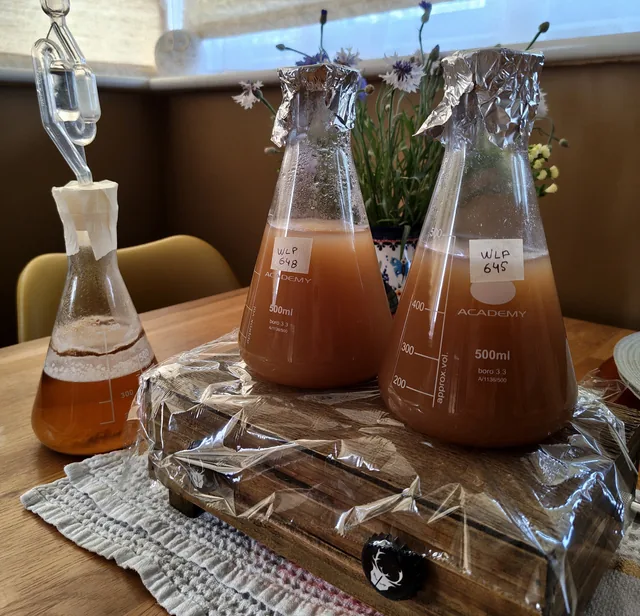 My hand-crafted double stir plate, making starters · 2026-06-27
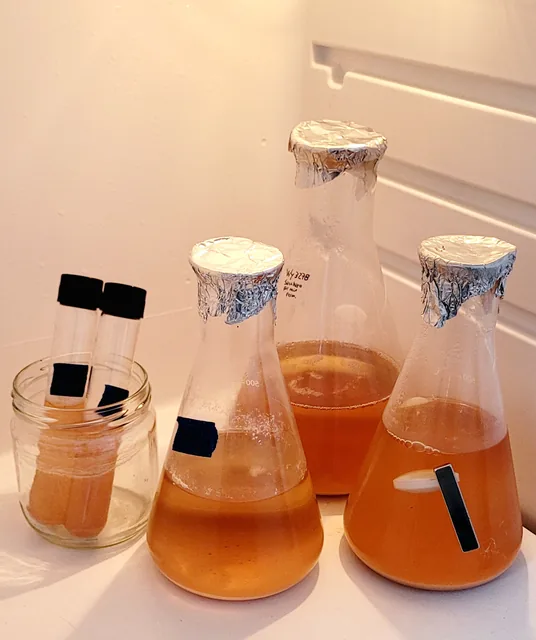 Prep for a single batch. I can mix and match as many as eight strains across Saccharomyces,
Brettanomyces and mixed cultures if I am splitting the batch · 2023-04-02
Prep for a single batch. I can mix and match as many as eight strains across Saccharomyces,
Brettanomyces and mixed cultures if I am splitting the batch · 2023-04-02
3. Protocol A — Ester-forward (tropical Brett primary)¶
Goal: maximum MCFA esters; ~3–4 months brew to glass.
- Pre-acidify wort to pH 4.0–4.2 with 88% lactic (~1 mL/5 L equivalent; verify by meter) — sharpens perceived esters and suppresses esterase.
- Pitch 100% Brett — most tropical-expressing strains (WLP645/648, Holy Goat isolates; else Cantillon + Brut du Ferment). Big pitch: ~2 mL slurry/L/°P ≈ 600 mL for 25 L at 1.050. Aerate hard pre-pitch (or O₂ stone when procured).
- Hold 23–24 °C steady. Aerobic days 0–5 (loose lid); sealed + airlock from day 5–7.
- Day 0: 25 mg p-coumaric to the batch. Day 3: 5 g nutritional yeast + 3 mL zinc stock (3 mg Zn). Optional: yeast hulls ~2.5 g at pitch (UFA source at pitch only + MCFA adsorption).
- Transfer to carboys at 2–3 weeks, fill to neck. LAB: optional and front-loaded, never co-fermented through the ester window — see §3.1 for why the previous "no Lacto, acidity competes with ester perception" rule was wrong and what replaces it. Week 2 of secondary: 2 g nutritional yeast + 5 mg p-coumaric per carboy.
- Weekly sensory pulls weeks 4–10; score pineapple/tropical, secondary fruit, off-notes. Bottle at peak, not plateau (peak window weeks 2–6 of active phase; bottling gate weeks 6–14 — see 03 §4).
- Cold crash 4 °C / 48 h → bottle within 1–2 weeks → EC-1118 → refrigerate once carbonated (2–4 weeks). Esters decay warm, even in bottle. Competition entries: young and cold (01).
3.1 Why "no Lacto" was the right call for the wrong reason¶
The stated rationale — acidity competes with ester perception — does not survive review:
- Low pH protects esters. Brett esterase is bidirectional with a pH optimum of ~7.6 (03 §4); the lower the pH, the slower the hydrolysis that ends the tropical peak. Step 1 of this very protocol acidifies in order to suppress esterase. Acidity is ester-preserving.
- The beer is already acidic either way. Pre-acidification to 4.0–4.2 means the objection, taken at face value, argues against step 1.
- Sour and tropical coexist commercially across mixed-fermentation and fruited-sour styles; there is no general antagonism to appeal to.
The real reasons to keep LAB out of weeks 2–14 are about timing and competition, and they are strong:
| Reason | Mechanism | Consequence |
|---|---|---|
| Clock conflict | A secondary LAB culture needs 8–12 weeks to reach its floor — precisely the weeks 2–6 ester peak and the 6–14 bottling gate | You judge the ester peak against a moving pH; the bottling decision is made on a target that is still travelling |
| Competition | LAB take residual sugars and amino acids during the only phase that synthesises esters | Lower ester output, not just different perception |
| Acetic route | Heterofermentative strains make acetic acid; acetic + ethanol → ethyl acetate | The one ester in the set that turns solventy first (03 §1) |
| Perception, stated correctly | Sourness suppresses sweetness, and residual sweetness supports the perception of tropical fruit | At fixed ester concentration a drier, sourer beer reads sharper and less juicy. Real, but an argument for controlling the degree of acidity, not for avoiding acid |
Revised practice. If acidity is wanted in an ester-forward beer, front-load it: kettle-sour or pre-acidify to the final target before the Brett pitch, so souring is complete before ester accumulation begins. Target pH 3.6–3.8 for ester-forward (versus 3.4–3.6 for funk-forward). Fast homofermentative L. plantarum in the kettle is the clean route (§5 table); a secondary LAB co-ferment is not. Keep at least one carboy at the plain 4.0–4.2 pre-acidification as the control — this is a two-carboy question and it has never actually been tested here.
4. Protocol B — Funk-forward (sequential pitch)¶
Goal: 4-EP/4-EG/4-EC accumulation; 12–24 months; blending-ready output.
- Primary: POF+ Sacch alone, 22–23 °C, ~2 weeks. Day 0: 50 mg p-coumaric + 1 green coffee capsule (vodka slurry) to the batch — see 04 §12 for the revised split (Day 0 now carries ≤30% of the p-coumaric budget, remainder staged onto the sampling cadence). Day 3: 5 g nutritional yeast.
- Secondary: Brett blend pitched per carboy at transfer (e.g. Boon + Brut du Ferment/Wy5112 core; decide based on availability and expected profile).
- Temperature: 23–24 °C months 2–9, then 22 °C (activation → maturation, 04 §7).
- Optional LAB per carboy for the lactic backbone (§5). Leave 1–2 carboys unsoured for blending range.
- Week 2 per carboy: 2 g nutritional yeast + 1 mL zinc stock (1 mg Zn). Week 6: 8 mg p-coumaric + 0.5 capsule. Week 12 sensory checkpoint: strong → skip rest; subtle → 5 mg + 0.5 capsule; off-character → stop and troubleshoot. Month 4–5: 1 g nutritional yeast.
- Month 6+: sample every 6–8 weeks (micro-oxygenation dose); no sugar additions needed while fermentation is ongoing.
- Bottle on taste at 12–24 months; cold crash 48 h; EC-1118; 4–6 weeks to carbonate; cellar conditioning continues development. Blend first where warranted (06).
5. Acidity backbone (controlled LAB)¶
Low pH brightens 4-EP, sharpens 4-EG, and stops well-made funk reading flat. Target: pH 3.4–3.6, TA 4–6 g/L lactic equivalent, lactic:acetic 5:1–10:1.
Correction — Wyeast 5335 is Lactobacillus buchneri, not L. delbrueckii. Wyeast catalogue it as L. buchneri and recommend use below 10 IBU. This matters, because buchneri is heterofermentative: it produces acetic acid and CO₂ alongside lactic, and under sugar limitation it is the species best known for converting lactate itself into acetate and 1,2-propanediol. That is the opposite of a clean 5:1–10:1 lactic:acetic backbone. Every earlier note in this project recommending "L. delbrueckii (Wyeast 5335)" was conflating a desired species with an actual product. (High confidence on the species; medium on how much acetate it contributes at our sugar levels.)
The behaviour previously wanted — a soft acidity that self-limits around pH 3.5 and needs no intervention to stop — is real, but it belongs to low-acid-tolerance delbrueckii-type homofermenters, which in practice means WLP677, not 5335.
Second correction — the pH target is now a funk decision, not just a flavour decision. VPR has a pH optimum of 5–6 (04 §11); every 0.1 pH down costs conversion rate. Driving a funk carboy to 3.2 for acidity's sake slows the very thing the carboy exists for. Sequence acidity before the funk window (kettle sour, pre-acidify) or after it (late LAB pitch, blending with an acid donor) rather than running both at once in the critical months.
Strain comparison¶
| Product | Species | Ferment. type | Practical pH floor | Hop tolerance | Temp range | Speed | Recommended here? |
|---|---|---|---|---|---|---|---|
| WLP677 | L. delbrueckii (identity disputed; behaves as a soft, slow acidifier) | Effectively homolactic in practice | ~3.2–3.4; soft, gradual | to ~20 IBU (claimed) | 32–47 °C optimum; works slowly at ambient | Slow (weeks) | Yes — first choice for a secondary backbone. This is the strain the protocol always meant |
| Lallemand WildBrew Sour Pitch | Lactiplantibacillus plantarum | Facultatively heterofermentative (homolactic on glucose) | ~3.2 | ~0 IBU | 32–38 °C | Fast (24–48 h) | Yes — first choice for kettle souring and for front-loading Protocol A. Dry, no starter |
| Fermentis SafSour LP 652 (new option) | Lactiplantibacillus plantarum | Facultatively heterofermentative | ~3.2–3.5 | Low | ~32 °C ±5 | Very fast (24–36 h) | Yes — the most convenient pre-acidification route. Direct pitch, dry, no starter; use where LP 652's slightly higher floor is wanted |
| Pediococcus damnosus (WLP661 / Wy5733) (new option, not a Lactobacillus) | P. damnosus | Homofermentative | ~3.2–3.4 over months–years | Hop-tolerant | Ambient | Very slow (months) | Yes — the correct organism for a 12–24 month funk carboy. Slow bound-HCA liberation that synergises with Brett VPR (07 §4). Accept the diacetyl/ropiness phase; Brett clears both |
| WLP672 | Levilactobacillus brevis | Heterofermentative | 3.0–3.5 | <10 IBU | 21–35 °C | Slow | Situational — sold for long secondary ageing, but it is an acetic producer. Only if a vinous edge is wanted |
| Wyeast 5335 | L. buchneri (not delbrueckii) | Heterofermentative | ~3.2–3.5 | <10 IBU | 16–35 °C | Slow; 5–7 day starter needed | No for a clean lactic backbone — acetic co-production, plus lactate-to-acetate conversion risk. Supersedes the earlier recommendation |
| Wyeast 5223-PC | Levilactobacillus brevis | Heterofermentative | ~3.3 | to ~20 IBU | 32–35 °C | Moderate | No — same acetic objection; kept in the table so it is not re-considered |
| Omega OYL-605 | L. brevis + L. plantarum blend | Hetero + facultative | 3.0–3.2 | 0–2 IBU | 18–35 °C | Fast | Situational — overshoots the 3.4–3.6 target. Reserve for aggressive Cantillon-style or acid-donor work |
| Bootleg Biology Sour Weapon L (new option) | L. plantarum blend (kveik-derived) | Facultatively heterofermentative | 3.0–3.5 | 0 IBU | 29–37 °C | Very fast | Situational — excellent kettle-sour performer, floor a little low for an unattended secondary |
pH floors are working figures from vendor data and Milk The Funk aggregation, not measurements in this system; wort composition and pitch rate move them by a tenth or two. Medium confidence throughout. Reclassification note: the 2020 split of Lactobacillus means L. brevis is now Levilactobacillus brevis and L. plantarum is Lactiplantibacillus plantarum; vendors still use the old names on packaging.
Practical trajectory (secondary pitch, one pack per 5 L directly at secondary start, no starter): ~4.2 → 3.9 (wk 2–3) → 3.7 (wk 4–6) → 3.5–3.6 (wk 8–12). Underpitching stretches timeline, not endpoint. LAB do not survive in finished beer — buy fresh each time. Aged hops keep IBU low enough for all of the above; a fresh-hop addition does not.
Per-batch decision:
| Profile wanted | Approach |
|---|---|
| Mild, saison-adjacent | WLP677 in secondary, no pre-acidification |
| Moderate gueuze | Pre-acidify to 4.2 + WLP677 in secondary |
| Long funk carboy (12–24 months) | P. damnosus for the slow backbone; lets the funk window run at a higher pH first |
| Aggressive sour | L. plantarum (kettle or secondary, unhopped) |
| Ester-forward (Protocol A) | Front-loaded only: kettle-sour or pre-acidify to 3.6–3.8 before pitching Brett; no secondary co-ferment (§3.1) |
| Fruit/thiol showcase | Skip LAB; fruit acids + Brett contribution |
| Acid donor for blending | L. plantarum kettle sour to pH 3.0–3.1 |
Brett alone cannot reliably supply the backbone — pushed hard it goes acetic + THP via the oxygen it needs.