Blending, Donors & Packaging¶
Version 1 · Disclaimer
Merges the donor/blending strategy with traditional gueuze blending practice and bottling mechanics. The donor system is this programme's core precision tool: over-shoot deliberately in dedicated vessels, calibrate at bottling.
1. Why blending works¶
4-EP/4-EG/4-EC are stable and dilute linearly: a 2,500 µg/L 4-EP donor blended 1:4 into a 200 µg/L recipient lands ~660 µg/L — upper traditional range. Band-aid is a concentration phenomenon, not a different compound; dilution genuinely fixes it. This mirrors commercial gueuze practice, where individual barrels are routinely unbalanced alone.
Blending fixes: phenol overshoot, one-dimensional character, low-funk recipients needing a lift. Blending does not fix: THP (threshold too low), isovaleric (cheesy — dilutes to less-unpleasant, never gone), volatile sulfur, extreme acetic. Donor rule: high phenols but otherwise clean or it contaminates the recipient.
2. Donor system¶
- Strategy A — dedicated donor: brew one 5 L Use-Case-C donor per year (04 §5); 2× spike rate, 24–25 °C, no fruit, same Brett blend as recipients; useful from 6–12 months. One donor doses ~25 L of recipients at 10–25% blend rates.
- Strategy B — split-batch donor: rack 5 L off a standard batch post-primary, over-spike that portion only. Identical base character → seamless integration; no advance planning; costs 5 L of drinkable output.
- Rolling programme (target state): one dedicated donor per year + split-batch donors as brews allow → a library of distinct profiles (4-EP-forward, 4-EG-forward, 4-EC-deep, oak-aged) matched to recipients at bottling. Ceilings: donor 4-EP ≤ ~3,500 (hard ~5,000), 4-EG ≤ ~2,500, 4-EC ≤ ~1,200 µg/L.
- Acid donor: L. plantarum kettle-soured batch at pH 3.0–3.1 gives independent acidity control at the blending bench.
3. Bench blending method¶
- Taste donor and recipient separately; note dominant phenol character. Complementary skews (EP-donor + EG-recipient) add complexity; same-skew adds only intensity.
- Trial blends: 50 mL recipient + 5/10/15/20 mL donor; clean glass each; room temperature (cold mutes phenols); notes immediately; ≤4 trials before palate reset; water + plain cracker between.
- Typical landing zone 10–25% donor. Scale up at bottling; bottle-conditioning doesn't materially shift the phenol balance.
- Bottle straight if a carboy is already balanced — blending is correction, not ritual.
4. Traditional gueuze blending (for the competition-facing blends)¶
- Classic frame: ~60% 1-year / 30% 2-year / 10% 3-year — by taste, not calendar (Tilquin blends 1+2 only; Lou Pepe all-2-year).
- The young component supplies residual fermentables for refermentation; the old supplies character. In this programme's compressed frame: "young" = a 6–9-month carboy with gravity still a few points above terminal.
- Measure both pH and TA of every component; TA predicts blended sourness better than pH. Model lactic:acetic; keep the blend lactic-dominant (5:1–10:1).
- Dump criteria: butyric (vomit), extreme ethyl acetate, unresolved musty mould, harsh acidity with no redeeming character after 2+ years.
5. Bottling & carbonation¶
- Always repitch at bottling: EC-1118 (house standard — pH-tolerant, fast, scavenges THP). Rehydrate, ~1 g per 20 L equivalent is ample.
- Verify gravity stable (two readings 4–6 weeks apart) before priming; Brett attenuates dextrins for months — priming on an unstable base over-carbonates.
- Priming targets (01): gueuze 3.0–4.0 vol (champagne glass only, cork + cage or cap); fruit lambic 2.5–3.5 vol (account for any fresh-fruit sugar); ester beers ~2.5 vol, carbonate warm 2–4 weeks then refrigerate.
- 375 mL corked + capped presents well at competition; check the competition's bottle rules before entry (some require plain caps).
- Gueuze conditions 6 months–2 years in bottle; ester beers do not improve in bottle — drink/enter early.
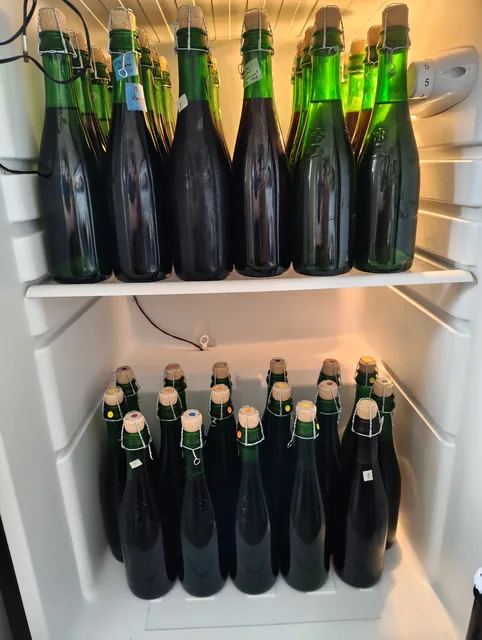 The one day I had to re-prime and re-cork a batch of 375 mL bottles that had leaked CO₂ · 2026-04-01