Lambic Fundamentals¶
Why homebrewed Lambic-style beers are worth the trouble¶
Lambic is a difficult beer to make at home. It takes time, patience, space, and quite a lot of willingness to accept that you will not always know where things are going. And yet, for many of us, that is exactly what makes lambic so fascinating.
The attraction is the beer itself. A good lambic can be incredibly refined and complex. It can be dry, sharp, fruity, earthy, funky, spicy, woody, vinous and sometimes surprisingly fresh, all at the same time. The individual flavours can be quite subtle, but together they create something that is difficult to reproduce in any other style of beer. There is always something else to find in the glass and each beer, and to some extent each pour is unique.
As homebrewers, we also have an opportunity to take part in that process in a way that is very different from just following a recipe. We may start with an idea of the beer we would like to make. Sometimes that idea is quite specific and often not. We might imagine a particular fruit character, a certain level of acidity, more funk, more freshness, a beer with a particular balance between fruit and fermentation character.
Then the beer starts to develop.
Over time, we taste our beers and start thinking about where they could go next. We might have several vessels that have developed differently, and each one gives us something to work with. One might have beautiful (or rather ugly) acidity. Another might have more fruit, more funk, or none of that. Another might have a character that we never expected but really like. We start imagining how these different pieces might be steered individually or work together.
This is where lambic homebrewing becomes particularly interesting. We are not simply trying to reproduce a traditional beer. We are making decisions based on flavour, taste and purpose. We taste what we have, imagine what it could become, and make choices that take us closer to the beer in our heads. Sometimes those choices add another layer of complexity. Sometimes they change the balance completely. And sometimes the beer takes us in a direction we had not imagined at all.
Flavouring and blending is part of this, and what I enjoy the most. So is helping steer how a particular beer may develop over another six months. So is deciding what a particular fruit, spice, wood, or other ingredient might contribute to a beer that already has a life of its own. So is deciding when to leave it alone. With several vessels developing at different speeds, the possibilities multiply. We can taste them individually, imagine combinations, and gradually build something that is more than any one of the individual beers.
None of this means that we have complete control. Quite the opposite. The organisms are doing a great deal of the work, and they do not always follow our plans, nor their imagination matches ours. That uncertainty is part of the appeal. We provide the starting point, create the conditions, make choices along the way, hope, keep hoping, and then see what the beer gives us.
That is why the long process is worth it.
Lambic rewards attention and perseverance. The longer we work with it, the more we learn to recognise the small differences in aroma, acidity, fruit, funk and texture, and the more interesting the decisions become. A beer that seemed simple six months ago can become something remarkably complex with another year of development.
For a homebrewer, that makes lambic less about following a recipe and more about developing a sense of flavour. We start with an idea, make a beer, taste it, imagine what it could become, and then work with what we have.
And eventually, after all that time, we get to pour a glass and find out whether the beer in the bottle matches the beer we had imagined, and if it does not, we just rebrand it and pretend that's what we intended in the first place.
The stern half¶
The freedom to develop a beer over years does not mean we can leave everything to chance. If anything, the opposite is true. Lambic gives us a great deal of room to influence the final beer, but we need to understand what we are doing if we want to use that room well.
Time is the unforgiving part. A decision made in the first fortnight may not show itself for another year or two, and by then there is very little that can be done to that particular beer. We may be able to blend around it. We cannot go back and brew it differently.
This is why the fundamentals matter and very little of it is the boilerplate of good brewing.
We calculate what goes in. Precursor doses are worked out in milligrams, from stocks of known concentration, against targets in micrograms per litre, with a stated conversion efficiency and a stated loss.
We stage those doses rather than dumping them in, because the two steps of the pathway run at different speeds. The decarboxylation is fast and the reduction is slow, and anything sitting in between as an intermediate is free to be stripped by CO₂, oxidised, or trapped by fruit anthocyanins on the way past. Matching the input to the throughput is worth more than the size of the dose.
We treat oxygen as a quantity rather than a contaminant. The sampling lift every four to six weeks is a dose. Too little and the reduction step runs short of the redox it needs; too much and we get acetic acid and mousiness. The cotton-bung experiment established the upper bound the expensive way.
We run temperature as a programme rather than a setting, because the enzyme we care about has an optimum some way above the shelf the carboys were sitting on.
We sequence acidity against the funk window instead of letting both run at once, because every tenth of a pH point downward costs conversion rate. Acidity is a funk decision as much as a flavour one.
We identify what we pitch and what we add. Knowing that something is a Brettanomyces is not enough when one species in the genus has no decarboxylase gene at all. Knowing the fruit is not enough either, because the form matters: a dried fruit carrying sulfite at ordinary retail levels can shut the pathway down completely. Record fresh, frozen, dried, concentrate or extract, and whether the label declares a preservative.
And we accept that having the precursors is necessary but not sufficient. Before deciding that a culture has failed us, we check whether the pathway was blocked rather than starved.
The same discipline applies to flavour. More funk is not automatically more complex, and more acidity is not automatically better. A balanced ratio between the ethyl phenols reads as complexity, while one of them alone reads as a one-note beer, and band-aid is not a different compound but the same one at the wrong concentration. The aim is not to maximise any particular characteristic. It is to build a beer where all the parts work together.
That also means being prepared to learn from our own brewing rather than from the reading alone. We should measure, keep records, taste on a schedule and, where practical, compare. Changing one thing at a time across a pair of carboys will tell us far more than changing five things and trying to work out afterwards what made the difference.
This matters more at our scale, not less. We do not have hundreds of barrels to average out our mistakes, or years of production data to fall back on. We have a few vessels, a limited amount of beer and usually a very long wait before we know whether an idea worked.
That makes good process even more important.
The goal of this wiki is therefore not simply to describe how lambic can be made. It is to help us make deliberate decisions and give our beers the best possible chance of becoming exceptional examples of the style.
There will always be things we cannot control. That is part of lambic. But there is a very large difference between accepting uncertainty and simply leaving things to fate.
Where the art lives at home¶
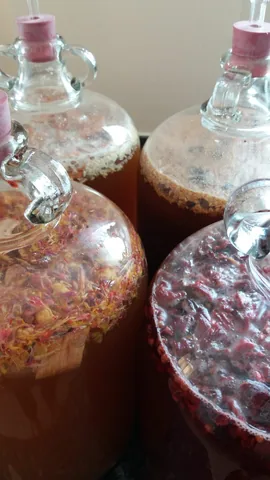
At home, however, we rarely have the luxury of a commercial blender's cellar. We might have a handful of carboys rather than hundreds of barrels, and every one of them represents a significant amount of time and beer.
That changes the way we work, and flavour imagination becomes an important part of the process.
Our blending decisions often start much earlier. We taste a beer while it is developing and ask ourselves what it could become. We might decide what flavours may match it, or whether it would benefit from more acidity, more fermentation character, or simply more time. We might have another carboy that has developed in a completely different direction and start wondering what the two would be like together.
The important thing is that these are not arbitrary additions. We are starting with a flavour concept and using the beer we have in front of us to work towards it. Sometimes an adjustment gives us exactly what we were looking for. Sometimes it adds or removes a layer we had not considered. Sometimes it changes the direction of the beer completely, and we decide that the new direction is better than the original idea.
And sometimes several carboys start to look interesting together.
Tasting them side by side, imagining or sampling different proportions and thinking about what each one contributes is a big part of the fun of brewing lambic at home. We may not have a large cellar to choose from, but we can create our own small collection of different profiles and use them creatively.
This is where the technical and creative sides of lambic brewing meet. The numbers, processes and controls give us good material to work with. The organisms create complexity that we could never produce ourselves. Our job is to understand what we have, decide where we want to take it, and make the best decisions we can along the way.
The result is hopefully a beer that is not just the product of fermentation and time, but one that reflects many deliberate decisions made by the brewer.
What this subsection is for¶
These pages are written for a homebrew programme, and they assume it throughout: pitched cultures rather than a coolship, a 25 L brew day split into 5 L glass carboys, and kitchen-grade measurement. There is no GC-MS behind any of it. Targets in µg/L come from the literature and from dosing arithmetic; verification is by taste, over time, against a control. Treat the figures as working figures and the confidence tags as load-bearing: High, Med and Low are used throughout, and Low means verify before acting.
The nine pages are a set and cross-reference each other by their original numbers, so a line reading "04 §5" means section 5 of the precursor page. The map:
| Ref | Page | What it is for |
|---|---|---|
| 01 | Style & Competition Targets | Where the beer has to land, and how it is judged |
| 02 | Succession, Organisms, Chemistry | The template everything else manipulates |
| 03 | Esters, Phenols, Enzymes | What makes the flavour compounds, and what removes them |
| 04 | Hydroxycinnamic Acid Precursor System | The funk pathway, its doses and its failure modes |
| 05 | Brew Protocols | The wort, the two protocols, the acidity backbone |
| 06 | Blending, Donors & Packaging | Donors, the bench, the bottle |
| 07 | Ingredients, Precursor Sources & Fruit Programme | What to put in, and what it carries with it |
| 08 | Stock Solutions & Chemical Storage | Making, dosing and storing the stocks |
| 09 | Observations Log & Open Questions | What actually happened here, and what is still unknown |
Read in order for the whole picture. For a specific problem, 04 §10 and 04 §11 are the diagnostic sequence, and 09 is the ground truth against which the rest is checked.
- Style & Competition Targets: BJCP 2021 vital statistics for lambic and the two Flanders sour browns, what judges reward and penalise, faults mapped to compounds, carbonation and entry timing.
- Succession, Organisms, Chemistry: The four-phase microbial succession, the organisms that drive it, the acid and flavour matrix, wort design principles, vessels and oxygen, and a troubleshooting table.
- Esters, Phenols, Enzymes: The two ester families and their precursors, the oxygen switch, esterase decay, temperature effects, and the Brett enzymes that release glycosides and thiols.
- Hydroxycinnamic Acid Precursor System: Why funk is inconsistent: the four hydroxycinnamic acid pathways, dose maths, pitching, temperature and oxygen strategy, the inhibitor audit, and dosing cadence.
- Shared Wort, Ester-Forward, Funk-Forward Protocols: Shared turbid wort for a 25 L batch, the ester-forward and funk-forward protocols, and the controlled lactic acid bacteria backbone with a strain comparison.
- Blending, Donors & Packaging: Why blending works, the donor carboy system, the bench blending method, traditional gueuze blending practice, and bottling and carbonation targets.
- Ingredients, Precursor Sources & Fruit Programme: Bound versus free precursors, precursor sources ranked by control, the ingredient and organism matrices, fruit chemistry for fruit lambic, and UK raspberry varieties.
- Stock Solutions & Chemical Storage: Preparing, dosing, storing and labelling hydroxycinnamic acid and zinc stocks, green coffee extract dosing, dry powder storage, and a supplier evaluation checklist.
- Observations Log & Open Questions: Empirical record of my own beers: process history, outcome patterns, strain dossier, additions that did and did not enable funk, settled failed experiments and open questions.
Home procedures
Everything here is experimental home practice, not peer-reviewed work. Read the disclaimer before following any of it.