Holy Goat Shrinebuilder
WB-BUG-2026-016 · stage: banked · started 2026-02-21
Current state
Banked as a single mixed Brett culture, Holy Goat Shrinebuilder - Brett, possibly two strains (shiny and dull colony types, recombined). Mini-beers were phenolic with no tropical notes, and nothing tried since has brought out the pineapple. Given up for now; I shall have a go in the future once more.
Source
A bottle of Shrinebuilder, Holy Goat Brewing (see the tasting note). The brewery describes it as fermented with a mixed culture including a blend of Brettanomyces strains isolated from Belgian lambic producers, showcasing an intense yeast character without fruit additions or hops: passion fruit, papaya, candied pineapple and apricot.
It is the most tropical, flavour-forward beer I have tried. Having messaged the brewery in the past, I knew a bit about their process, so I assumed the tropical flavours came from the Brett strains, which I decided I must add to my collection.
This is one of the cultures I have invested the most time in. Despite success in isolating the Brett, I have so far been unable to recreate those pineapple aromas: two steps forward and two backwards all along the way.
What else was in the bottle
Dregs diluted directly from the bottle: Saccharomyces and Brett cells, plenty of debris as expected, and bacteria (rod-shaped, single and in pairs). The plan was to isolate both yeasts and discard the bacteria.
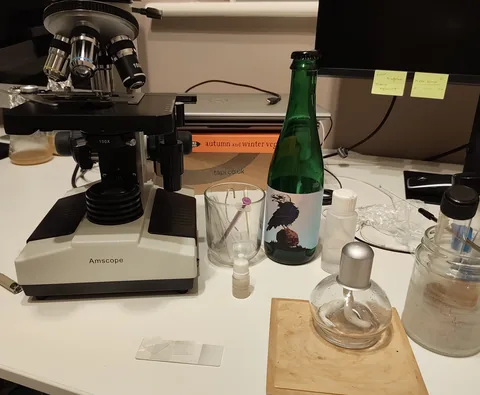 Bottle dregs inspection.
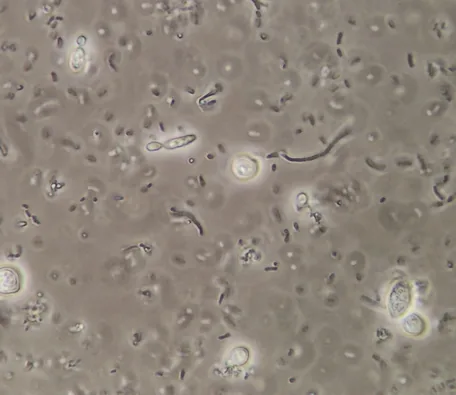 Bottle dregs · 1000x oil immersion, phase contrast, no stain
Plating and colonies
| Colony | Round | Medium | Days | Temp (°C) | Morphology | Notes |
|---|---|---|---|---|---|---|
| Brett | First plate | Wort agar | 14+ | ~21 | Tiny, smooth | Target; picked from isolated tiny colonies |
| Saccharomyces | First plate | Wort agar | 14+ | ~21 | Big, smooth | Picked and tested; discarded (presumptive bottling yeast) |
| Bacteria | First plate | Wort agar | 14+ | ~21 | Large, volcano-shaped | Not picked |
| Brett | Confirmation 1 | Wort agar | ~14 (typical) | ~21 | Small, smooth | One of two plates clean; the other had Saccharomyces |
| Brett | Confirmation 2 | Wort agar | ~14 (typical) | ~21 | Small, smooth | Repeated because round 1 was not 100% clean |
| Brett (shiny, dull) | Separation | Wort agar | ~14 (typical) | ~21 | Shiny and dull types | Separated, no difference found, recombined |
Getting the first plate right
The bugs grow at different rates, and the ones we are after are the slowest. It is not uncommon for bacteria to take over the plate, and sometimes fast-growing mould gets in the way. Getting the dilution right helps a lot: cells sufficiently separated, but still a few colonies of what you are after.
I don't plate directly from the bottle dregs; I revitalise them in sterile wort first. Luckily, the lacto in this sample appears to be hop intolerant, so it was slowed down while the yeast revitalised.
The plate was 2+ weeks old when the Brett colonies started to appear. Tiny and big smooth colonies are Brett and Saccharomyces respectively; the nasty-looking volcano-shaped ones are bacteria. Check colonies under a magnifying glass to avoid picking overlapping ones: the Brett colonies are barely visible to the naked eye, and it would be very easy to pick a Saccharomyces colony and scoop some Brett at the same time. Here the morphology was on our side: the bacterial colonies were huge (in my experience they are often tiny), and we were after the tiny colonies, so an isolated tiny colony was easy to find.
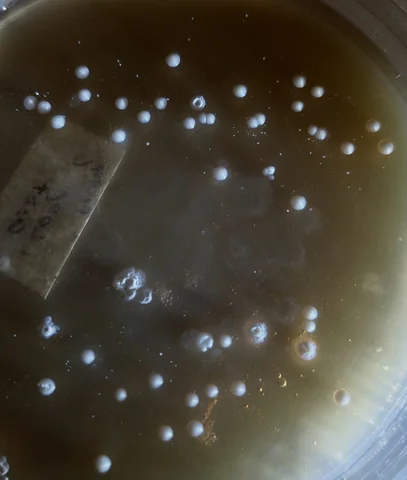 First plate · wort agar, 2+ weeks, ~21 °C
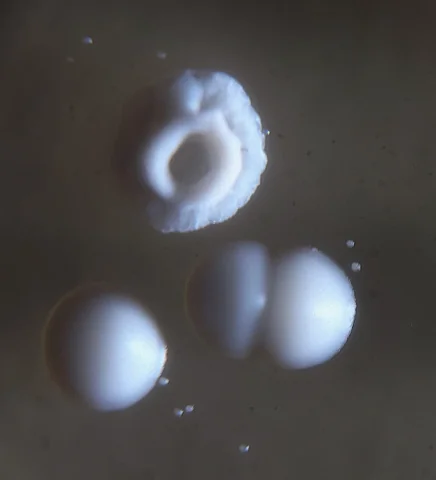 Three colony types, close-up · wort agar, ~21 °C
Confirmation rounds
I suspected the Saccharomyces colonies were bottling yeast, but isolated and tested them too, just in case. You never know.
The process: pick a handful of colonies and mix them in a small amount of water; repeat this two or three more times; check thoroughly under the microscope, discard any sample with cells that don't belong, then plate for confirmation. Multiple plates matter because, despite best efforts picking clean colonies and checking under the microscope, sometimes something sneaks in.
Both plates below were meant to have only Brett colonies, but one got some Saccharomyces in. Not sure how that happened, but that's why we do what we do. After the first confirmation round it is best to do at least one more round with the same process. Given I did not get 100% clean plates, I did another round.
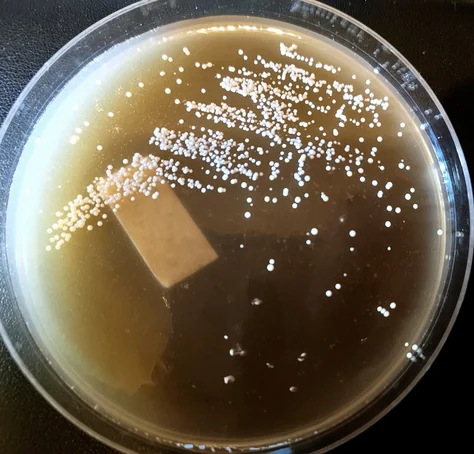 Confirmation plate: clean Brett · wort agar, ~21 °C
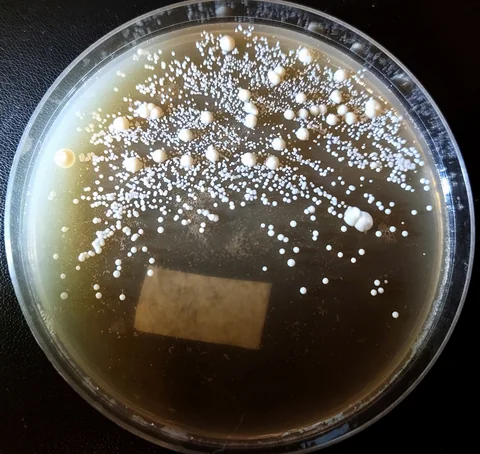 Confirmation plate: Brett with Saccharomyces contaminant (the larger colonies) · wort agar, ~21 °C
Tubes and banking
Once the plates are spotless, I pick 10–20 colonies into three test tubes of clear wort, plate once more and keep cultivating in the tubes. Wort without coagulated proteins floating around is much easier to work with: telling proteins from bacteria is time-consuming and in some cases difficult. For clear wort I pressure-cook the tubes twice: the first time drops the proteins, the second kills anything that got in while decanting the clear wort.
When a plate is confirmed clean, the matching tube can be banked and a mini-beer brewed to check what the new organism delivers.
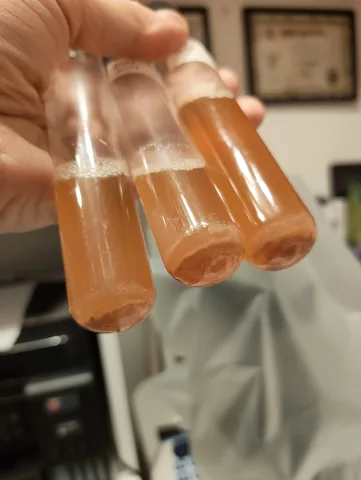 Brett tubes in clear wort
Shiny and dull colonies
The Brett confirmation plates appeared to show colonies with different characteristics: some shiny, others dull. I separated the two to evaluate them on their own (yes, all over again). Despite the difference on the plates, I could not see any difference under the microscope, and, most importantly, I could not perceive any flavour, aroma or colour difference in test-tube beer. So I mixed them back together.
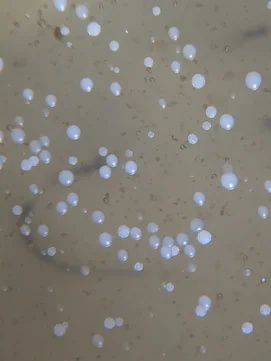 Shiny and dull colonies side by side · wort agar, ~21 °C
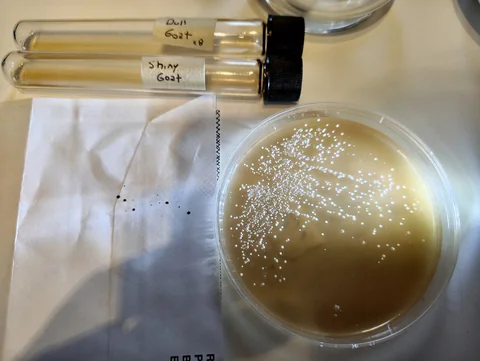 Hunting shiny and dull colonies into separate tubes
Microscopy
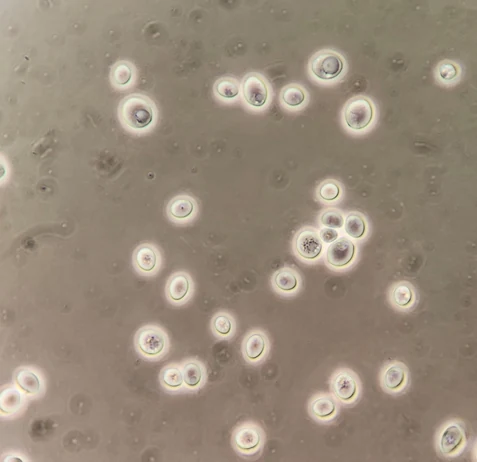 Saccharomyces isolate · 1000x oil immersion, phase contrast, no stain
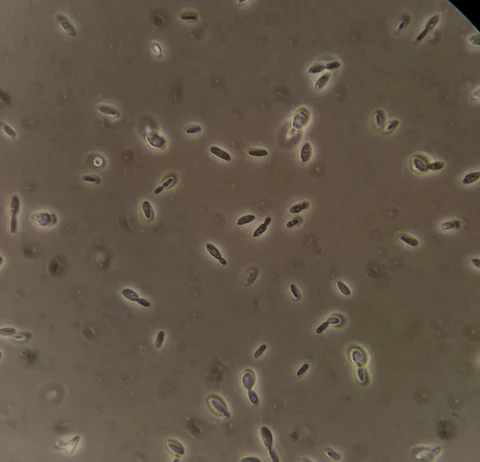 Brett isolate · 1000x oil immersion, phase contrast, no stain
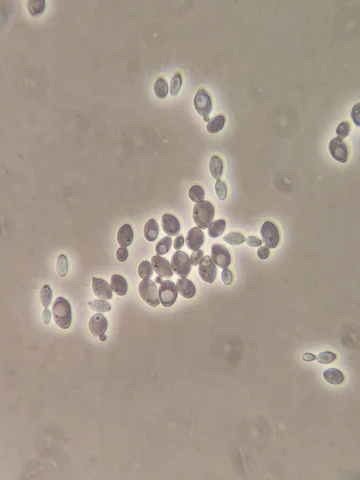 Shiny and dull Brett: no visible difference under the microscope · 1000x oil immersion, phase contrast, no stain
Outcome
- Holy Goat Shrinebuilder - Brett (WB-BUG-2026-011): banked Brett blend, shiny and dull colony types combined.
- Saccharomyces isolate: tested and discarded (presumptive bottling yeast).
- Bacteria: discarded.
Log
2026-02-21 · Source
Tasted Shrinebuilder: the most tropical beer I have tried. Dregs diluted directly from the bottle and examined: Saccharomyces, Brett, debris and rod-shaped bacteria (single and in pairs). Dregs revitalised in sterile wort before plating.
2026-03-12 · Plating: first plate
Wort agar, ~21 °C, 2+ weeks before Brett colonies appeared. Three colony types: tiny smooth (Brett), big smooth (Saccharomyces), large volcano-shaped (bacteria). The lacto appeared hop intolerant and was slowed during revitalisation.
2026-03-13 · Colonies picked
Isolated tiny (Brett) and big (Saccharomyces) colonies picked separately. Both checked under the microscope (1000x, phase contrast).
2026-03 · Confirmation plating (day not recorded)
Two Brett confirmation plates: one clean, one with Saccharomyces. A second confirmation round with the same process. Spotless plates then picked (10–20 colonies) into three tubes of double-pressure-cooked clear wort and plated once more. Brett banked as Holy Goat Shrinebuilder - Brett: two slants.
2026-05-01 · Mini-beers and later trials (2026-03 to 2026-05; individual dates not recorded)
- Saccharomyces: fermented in a test tube at ambient temperature (~22 °C). Super clean, super fast, no character whatsoever, so the bottling-yeast assumption was presumably correct. Discarded.
- Brett, test tubes: promising; the tube "beer" smelled faintly of tropical fruit.
- Brett, mini-beer: 200 mL in a 250 mL Erlenmeyer, 20 g DME, water < 50 mg/L alkalinity, ambient (~22 °C), 4 weeks. A total fail: typical phenolic notes, no tropical notes. Gravities not recorded.
- Shiny and dull colonies: separated and evaluated; no difference under the microscope or in test-tube beer. Recombined.
- Brett, repeat at 30 °C: same wort composition, 2 weeks. No tropical notes.
- Other attempts: different alkalinity levels and temperatures up to 30 °C, pretty much everything explored in Esters, Phenols, Enzymes (which this culture inspired). Nothing.
- Commercial strains: in the end I just wanted pineapple, from this yeast or not, so I bought WLP645 and WLP648. Tried alone and combined at 30 °C: nothing. Sad story.
Given up for now; I shall have a go in the future once more.