Mills Pils
Tasted 2026-09-18 · isolate: pass
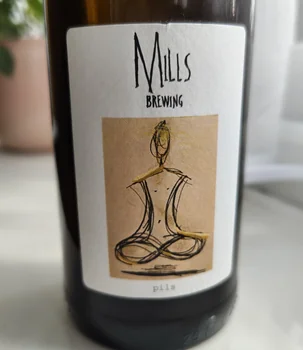 Mills Pils, Mills Brewing: mixed-fermentation lager.
Impression
Beautiful, minimalist label on a good-quality bottle. The aroma is genuinely lovely: heavy hopping on a mixed-fermentation base pushes the funk forward a lot more than an aged-hopped version would. On the palate the dry hop's cut-grass note sits right alongside the wild character, and for me that combination just doesn't work: it reads as an odd, slightly clashing note rather than something that integrates. Really interesting and funky, with a great story and an unusual process, but those notes tire and saturate the palate quickly, and I couldn't get through the glass without the fatigue setting in.
The bugs
As told by the brewery: coolship-cooled in December, then racked to large oak casks for secondary fermentation and lagering over winter with indigenous wild yeast and bacteria, dry hopped with whole leaf, bottle conditioned, and bottled the following July. Bottle-conditioned, so presumably live culture at bottling; dregs not examined, no plating done. Bottled Nov 2025, which does not quite align with the story they tell (i.e. winter brew, summer bottling)
I've hit the same dry-hop-over-wild-character clash before: a Brett IPA from Ørsted, brewed in a broadly similar way (ale base, wild secondary, dry hopped), was fantastic, and when I tried to replicate it at home from their own recipe I got the same sort of weirdness I'm tasting here, though Mills have clearly executed it better than my homebrew attempt did. Starting to look like a pattern with dry hopping over a wild character, not a one-off from either brewery.
Decision
Will not examine further. Enjoyed it and learned from it, but the dry-hop-over-wild-character combination isn't the direction I want, and I've now hit the same result from two different sources (Ørsted's recipe at home, and this). Will not plate or examine further as I cannot tell how different their brett may be from the ones I have banked already.