Stock Solutions & Chemical Storage¶
Version 1 · Disclaimer
Safety
Experimental home procedure. Read the disclaimer first.
Making, dosing and storing the stocks that precursor doses are measured from: hydroxycinnamic acid (p-coumaric, ferulic, caffeic) and zinc sulfate stocks, green coffee extract dosing, dry powder storage, and how suppliers and their certificates are checked.
1. Hydroxycinnamic acid stocks (p-coumaric, ferulic, caffeic)¶
Recipe — 10 mL at 10 mg/mL in 50% ethanol: 1. Weigh 100 mg (±1 mg) into amber glass. 2. Add 5.1 mL of ~98% ethanol; swirl to dissolve (hand-warm bath ≤40 °C helps; never hotter). 3. Add 4.9 mL distilled/boiled-cooled water; swirl.
50% ethanol is deliberate: neat-ethanol stock shock-precipitates on dosing into wort. Tap water degrades the acids — always distilled or boiled-cooled.
Dosing: 1.0 mL = 10 mg; 0.5 mL = 5 mg. 1 mL syringe; dose directly, swirl gently, CO₂ blanket if available.
Storage (importance order): amber/foil-wrapped against light (trans→cis isomerisation); fridge 4 °C, never frozen (freeze–thaw precipitation); sealed — septum vial + syringe is best practice; never return a used syringe to stock. Fresh stock is near-colourless pale yellow; deep yellow/brown/cloudy = remake. Shelf life ~6 months — prefer 5 mL batches over 10 mL; freshness beats volume.
Labelling (distinct bottle + colour per compound; Sharpie on glass as backup):
P-COUMARIC ACID STOCK
10 mg/mL in 50% ethanol — 1.0 mL = 10 mg
Made: [date]  Use by: [+6 months]  Batch: [supplier lot]
Observation — Possible to push concentration for pCA and FA to 20mg/ml, but failed to fully disolve at 40mg/ml.
2. Zinc sulfate stock¶
Source: OTC zinc sulfate tablets, 15 mg elemental Zn (co-formulated copper ~1 mg is harmless). Not zinc oxide (insoluble). Format ranking: sulfate > gluconate > oxide.
Recipe — 15 mL at 1 mg/mL elemental Zn: crush 1 tablet; into amber bottle; add 15 mL boiled-cooled water; swirl; stand 10 min; swirl. Excipient sediment is expected and doesn't affect dosing.
Dosing — 0.1–0.2 mg Zn/L, single dose per fermentation (catalytic cofactor; repeat dosing pointless, higher levels inhibitory):
| Vessel | Dose | Volume |
|---|---|---|
| 5 L carboy | 0.5–1.0 mg | 0.5–1.0 mL |
| 25 L primary | 2.5–5.0 mg | 2.5–5.0 mL |
Timing: day 3–5 of primary, or (funk-forward) week 2–4 of secondary to target sustained Brett activity.
Storage: fridge 4 °C, sealed. The salt itself is indefinitely stable; the limit is microbial growth in an unpreserved aqueous solution and the tablet's own excipients (binders, cellulose) settling and going off. Shelf life ~6 months refrigerated — 15 mL is already several batches' worth, so remake rather than scale up. Sediment is normal; cloudiness in the supernatant, film, smell or colour change = discard. Swirl to redistribute before drawing, but dose from the liquid, not the sediment. Never return a used syringe to stock.
Labelling (bottle and cap colour distinct from the HCA stocks — the volumes and syringes are identical and the two must not be confused):
ZINC SULFATE STOCK
1 mg/mL elemental Zn — 1.0 mL = 1 mg Zn
Dose: 0.1–0.2 mg Zn/L — ONCE per fermentation
5 L carboy = 0.5–1.0 mL · 25 L primary = 2.5–5.0 mL
Made: [date]  Use by: [+6 months]  Tablet: [brand / mg Zn / lot]
SHAKE — sediment expected
3. Green coffee extract dosing¶
Alpha01, ~110 mg chlorogenic acid per capsule. Open capsule into 10–30 mL warm vodka, stir to slurry, dose under CO₂ blanket. Half-doses: halve visually, or pre-make one capsule into 20 mL vodka and dose 10 mL; refrigerate, use within weeks. Expected yield ~250–400 µg/L 4-EC per capsule per 5 L (bound-form efficiency 3–5% overall, see 04 §5).
Make-up arithmetic, labels and use-by dates for these stocks: HCA dosing bench, Stocks tab.
4. Dry powder storage (bulk acids)¶
Dry acids are far more stable than solutions: 3–5 years properly kept (supplier 2-year expiries are conservative). Risks in order: moisture (mildly hygroscopic — sealed + indicating silica gel), light (slow photoisomerisation — opaque/dark), heat/oxygen (slow oxidation — cool).
Two-tier system: ~10 g in an airtight amber "working jar" (cupboard/fridge, 6–12 months of use); bulk vacuum-sealed or double-bagged + silica in the freezer. Always warm sealed containers to room temperature before opening (condensation). Never return exposed powder to bulk. Clean dry spatula only. Visual gate: white (p-coumaric) / off-white (ferulic), free-flowing; yellowed or clumped = discard.
At tens of mg per batch, 5 g of each acid is effectively a lifetime supply.
5. Supplier evaluation checklist¶
Before buying: CoA present and batch-matched; heavy-metals panel complete (Pb, As, Cd, Hg); residual solvent testing for extracts; stated isomer (trans) and purity (≥98%) for acids.
6. Sourcing and certification¶
What is actually in the cupboard, and what the paperwork says about it. The checklist in §5 is what to look for before buying; this section is the record of what was bought.
| Input | Product | Route | Key specification | Evidence held |
|---|---|---|---|---|
| p-Coumaric acid | Havenova Biotech, batch XH20260225 | Alibaba | ≥99%, CAS 501-98-4 | Certificate of analysis |
| Ferulic acid | Havenova Biotech, batch XH20251007, natural (rice bran) | Alibaba | ≥99.00% | Certificate of analysis |
| Caffeic acid | — | — | trans, ≥98% per §5 | none held |
| Zinc | Vitabiotics Ultra Zinc 15 mg with copper | Amazon | 15 mg elemental Zn per tablet | Retail packaging |
| Green coffee extract | Alpha01 organic green coffee extract, 90 capsules | Amazon | 220 mg chlorogenic acid per 2-capsule serving | Retail packaging |
6.1 Hydroxycinnamic acid certificates¶
Both acids come from the same supplier on separate batches. Certified values:
| Item | p-Coumaric (XH20260225) | Ferulic (XH20251007) |
|---|---|---|
| Assay (HPLC) | 99.52% (spec ≥99%) | 99.13% (spec ≥99.00%) |
| Identity | CAS 501-98-4, MW 164.16 | Oryza sativa L., rice bran; C12/C13 ratio 33 (spec 30) |
| Appearance | White crystalline powder | White to off-white fine powder |
| Manufactured / expires | 2026-02-25 / 2028-02-24 | 2025-10-07 / 2027-10-06 |
| Loss on drying | 1.53% (spec ≤7%) | 1.20% (spec ≤5.0%) |
| Ash | 2.17% (spec ≤7%) | 1.17% (spec ≤5.0%) |
| Heavy metals | ≤10 mg/kg; As ≤0.5, Cd ≤1, Pb ≤1, Hg ≤0.5 — conforms | ≤10 ppm; As ≤1.0, Pb ≤1.0, Hg ≤0.5 — conforms |
| Residual solvents | Methanol ≤3000 ppm, acetonitrile ≤410 ppm, ethyl acetate ≤5000 ppm — conforms | Water and ethanol only; no excipient |
| Microbiology | TPC ≤1000 cfu/g, Y&M ≤100 cfu/g; E. coli, Salmonella, Staphylococcus absent | TPC ≤1000 cfu/g, Y&M ≤100 cfu/g; E. coli, Salmonella not detected |
Three things worth taking from this:
- The p-coumaric CAS number settles the isomer. 501-98-4 is trans-4-hydroxycinnamic acid, so the §5 requirement for the trans isomer is met on paper for that acid. The ferulic certificate states no CAS number and no isomer, which is the one specification in §5 it does not answer. Ask the supplier before the next order. (High on the CAS identity; the ferulic gap is simply absent data)
- The residual-solvent limits are irrelevant at brewing doses. Worst case, a 50 mg p-coumaric spike carrying methanol at the full 3000 ppm limit puts 0.15 mg of methanol into 25 L, about 6 µg/L. Table wine sits four to five orders of magnitude above that. Recorded so it is not re-examined.
- Two-year expiries corroborate §4. Both certificates give two years from manufacture, which is the conservative figure §4 already assumes; the dry powders themselves keep longer under the two-tier storage described there.
Both certificates, at full size. The tester, checker and approver names and the supplier's contact footer are whited out; nothing else is altered. Click either one to read it.
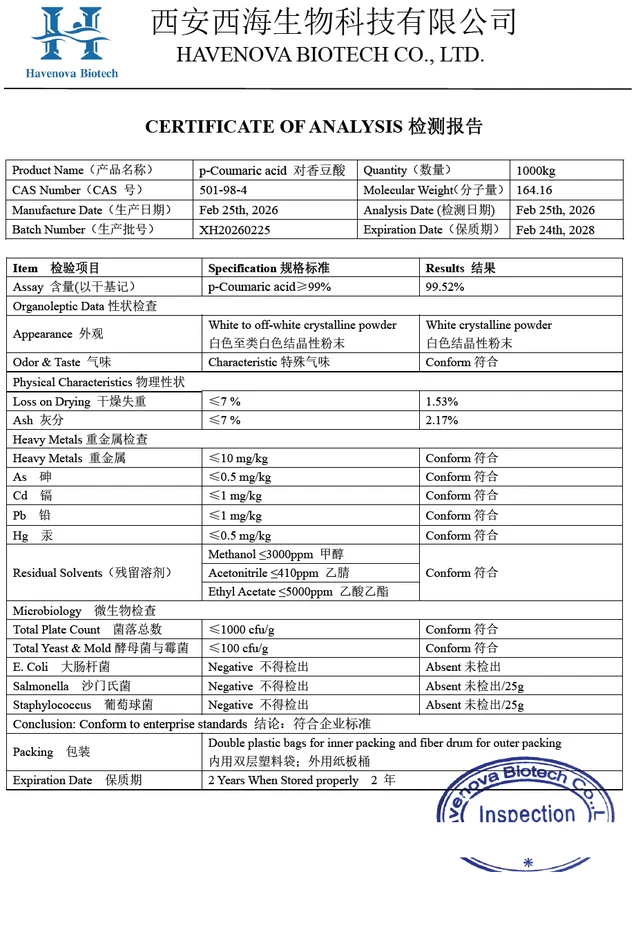
p-Coumaric acid, batch XH20260225, analysed 2026-02-25.
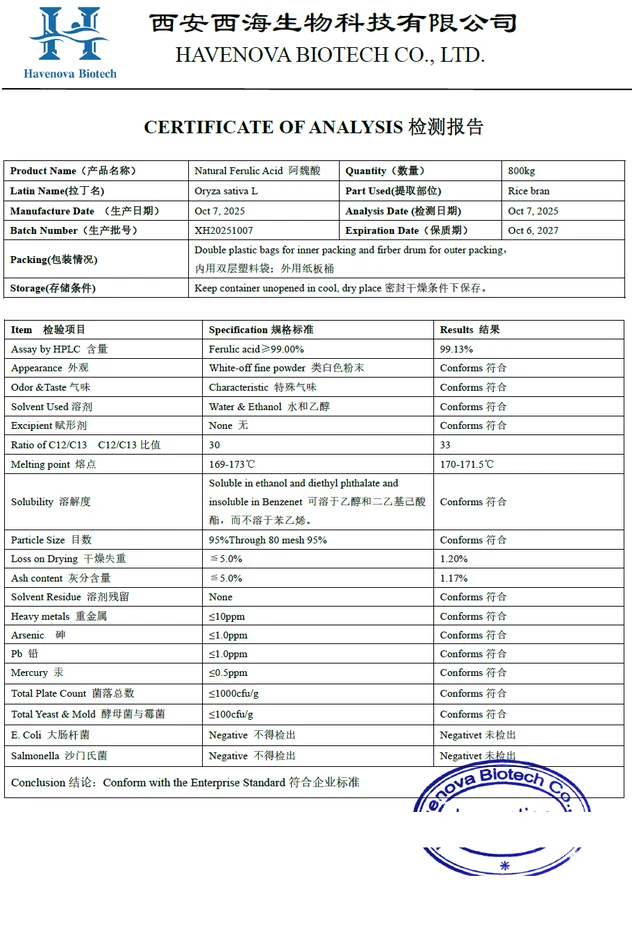
Ferulic acid, batch XH20251007, analysed 2025-10-07.
6.2 Zinc tablets¶
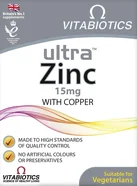
The tablet source for the §2 stock. Zinc sulfate is not stated on the front of the pack; the salt form has to be read off the ingredients panel.
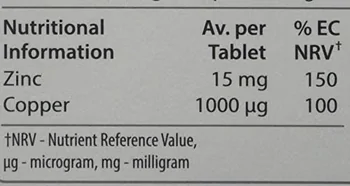
15 mg elemental Zn and 1000 µg Cu per tablet, which is the basis of the 1 mg/mL stock in §2.
The copper rides along at 1 mg per 15 mg Zn, so a dose that lands 0.2 mg/L of zinc also lands about 13 µg/L of copper. 04 §11.1 lists Cu²⁺ among the in-vitro PAD inhibitors, with the same caveat it applies to zinc: the assays use concentrations orders of magnitude above this. No action, recorded for completeness.
6.3 Green coffee extract¶
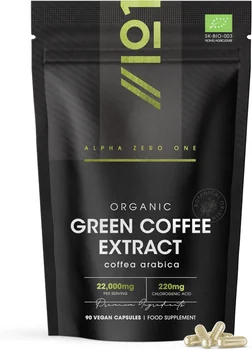
The capsule source for the §3 caffeic route.
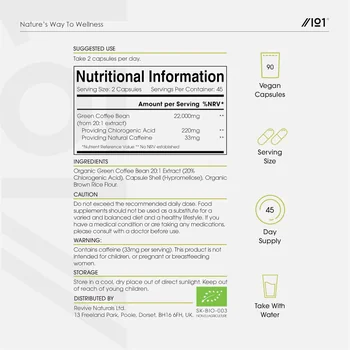
220 mg chlorogenic acid per 2-capsule serving, so 110 mg per capsule. Ingredients are the 20:1 extract, a hypromellose shell and organic brown rice flour.
- The 110 mg per capsule figure used throughout 04, 07 and §3 is confirmed by the label and is internally consistent: 22,000 mg bean equivalent per serving at 20:1 is 1,100 mg of extract, 550 mg per capsule, and 20% of that is 110 mg chlorogenic acid.
- Caffeine comes with it: 33 mg per serving, so 16.5 mg per capsule, about 3.3 mg/L when one capsule goes into 5 L. That is a small fraction of brewed coffee and well under any sensory threshold, but it is a real addition and accumulates if capsules are staged.
- Brown rice flour is the ballast that does not dissolve in the vodka slurry (§3). Expect sediment; it is excipient, not undissolved extract.