Timmermans Lambicus Blanche: tasting note
Tasted 2026-10-25 · pass
Not isolating
- Isolate: none.
- Why: a wit base, as the beer research showed, which matches the ester profile; I am just not fond of it.
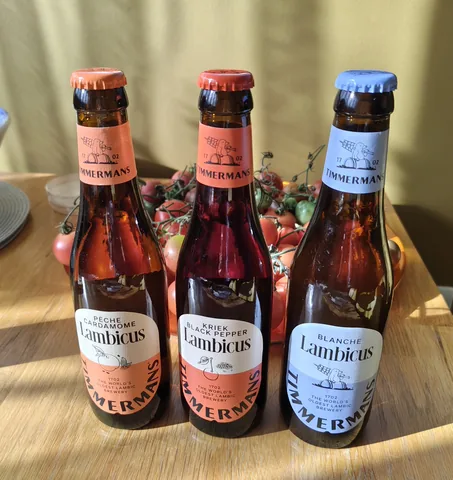 The Lambicus line-up: Pêche Cardamome, Kriek Black Pepper and Blanche.
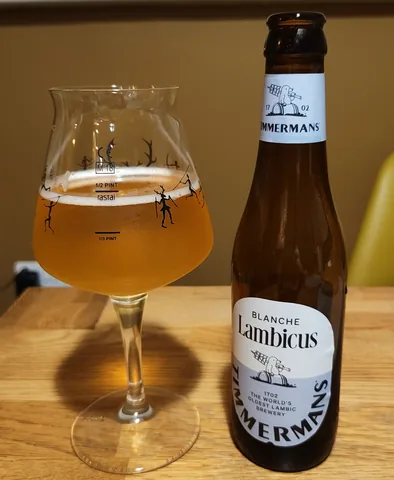 Lambicus Blanche in the glass.
Impression
Timmermans' Lambicus beers have turned up in a supermarket near me, and I had high hopes: a readily available lambic at a good price would be a great find. I tried the Blanche first and, unfortunately, disliked it. The witbier ester profile is exaggerated, and I found the beer cloying and overpowering.
I also tried the Pêche Cardamome, and it did not work for me either: the peach is overdone and slightly artificial, sitting on top of the esters from the base beer. I have yet to try the Kriek Black Pepper, which I am told is the best of the three. I am slightly gutted, as I was hoping this could become a "table lambic" for me.
The beer
Researched 2026-10-31 from published sources (numbered below), not the author's own observations.
| Item | Finding |
|---|---|
| Brewing | A wit-style beer with coriander and dried orange peel, blended with lambic [1][2][3]; one retailer quotes the brewery as "made from young lambic" [4]. The lambic: barley malt and at least 30% unmalted wheat, turbid two-step mash, aged hops at a high rate [1]. 12 °P and 14 IBU per one retailer [5] |
| Organisms | Lambic part spontaneous: overnight in a copper coolship, brewed September to spring [1][2]. The yeast of the wit part and the lambic share are not public |
| Fermentation and ageing | Oak or chestnut port pipes (650 L) and foeders of 45 hL and more [2]; lambics in the brewery's beers generally 18 to 36 months old [2] |
| Blending | Lambic plus wit beer; proportions not public. Created in the 1990s, in 33 cl bottles since the 2023 relabel [3] |
| Packaging | Crown-capped 33 cl, 4.5% ABV [3][7]. One ingredient list adds sugar, flavourings and ascorbic acid [6]. 40 kcal per 100 mL [7], which leaves roughly 35 to 40 g/L carbohydrate after the alcohol [Med]. Filtration and pasteurisation not public |
| Pêche Cardamome | Barrel-aged lambic with fruit and cardamom, 4.0% [8], from the Fruit & Spice range launched in 2023 [3] |
What it means for the bugs:
- The beer is sweet: with live yeast it would referment, so it is very likely pasteurised or sterile-filtered [Med]. Cells in the dregs are then mostly dead; the microscope cannot tell.
- Anything that does survive mixes the wit yeast with lambic flora, not a recoverable house culture [Med].
Sources: 1. Timmermans and the magical mystery tour that creates the ancient style of lambic beer, Protz on Beer, 2014. 2. Brouwerij Timmermans: The World's Oldest Lambic Brewery, Celebrator Beer News, 2018. 3. Fruit & Spice Lambicus launch and portfolio change, Lambicland News, 2023 (Dutch). 4. Timmermans Lambicus Blanche, Finest Shop (retailer). 5. Lambicus Blanche, Bierothek (retailer). 6. Timmermans Lambicus Blanche, Open Food Facts, 2026. 7. Timmermans Blanche Lambicus 330ml, Morrisons (retailer), 2026. 8. Pêche Cardamome Lambicus, Artisanal Imports (importer).
The bugs
Under the microscope the dregs showed many different yeasts and bacteria. A selection, with sizes measured on the photos; the identifications are from cell shape and size only.
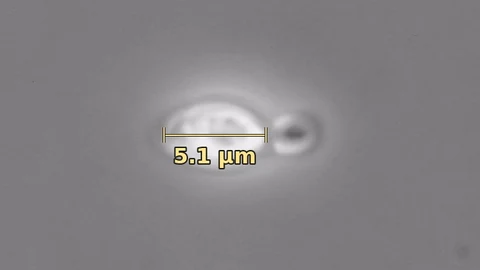 Oval cell with a polar bud, 5.1 µm long: Brettanomyces-like [Low] · 1000x oil immersion, phase contrast, no stain
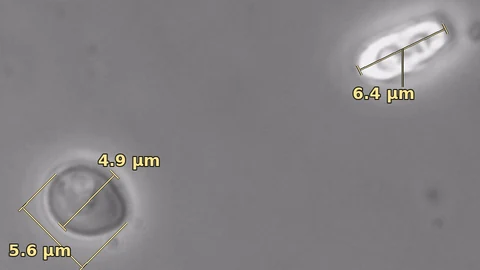 Left: round-oval cell, 5.6 x 4.9 µm, Saccharomyces-like; phase-dark and granular, possibly dead [Low]. Right: cylindrical cell, 6.4 µm long, Brettanomyces-like [Low] · 1000x oil immersion, phase contrast, no stain
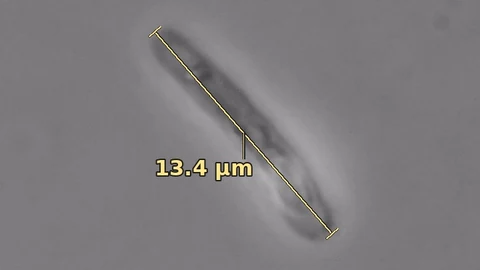 Elongated cell, 13.4 x 2.1 µm, possibly with a septum: a stretched yeast cell, Brettanomyces or a film yeast [Low] · 1000x oil immersion, phase contrast, no stain
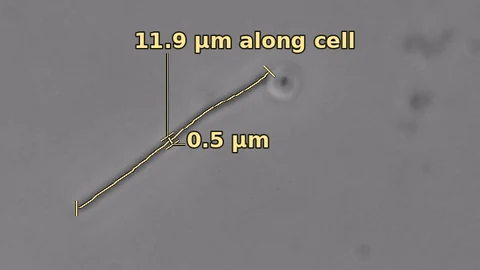 Long thin rod, 11.9 x 0.5 µm: a lactic acid bacterium, Lactobacillus-type [Med] · 1000x oil immersion, phase contrast, no stain
Decision
Pass. I am not trying to isolate any of them, as I disliked the beer's profile. The bacteria were the only draw, but they are not worth going after with so many other organisms around them that I am not interested in.